Jump to section
- President’s welcome: Let’s support and learn from each other in this time of change
- News: Government goes smaller for LGR in Essex, Hampshire, Norfolk and Suffolk
- News: Hull leads decade of broadband progress
- News: Milton Keynes pilots shopping centre voting hub
- News: Nations and regions
- Main feature: Lessons from 4×40 years of Socitm’s experience
- Research view: Then, now and next for five digital trends
- Personal view: Following the data to a sustainable future
- Socitm overview: How Socitm can help with local government reorganisation
- Local and national events
President’s welcome: Let’s support and learn from each other in this time of change

Welcome to the magazine and to those of you taking the time to attend the President’s Conference. In particular, a very warm welcome to our new members and our partners who support and make this special occasion possible.
This event celebrates 40 years of Socitm members supporting, collaborating, working with and learning from each other. My journey to becoming your president started with Socitm’s excellent leadership programme, including a Top Talent course, and positive support over the years which has helped me build greater confidence in my role at Norfolk. Development of leadership talent is something which is core to Socitm’s DNA.
Given our conference’s focus on moving from legacy to leadership, this issue’s main feature asks four leaders with long experience of our sector what shaped their careers and what will be required of those who lead local public service technology and innovation in the future.
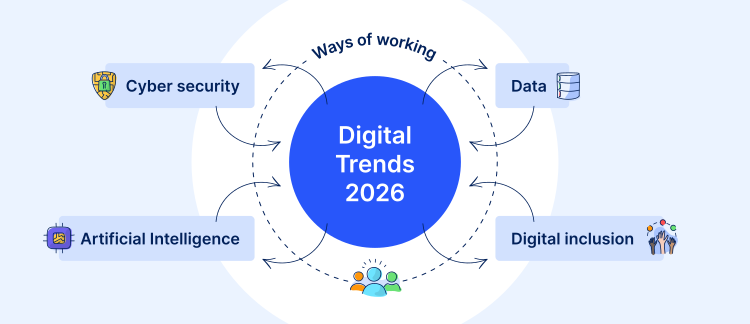
Socitm has published research since its earliest days and now provides a wide range of material to support you in developing your career. If you haven’t explored the annual digital trends research you can read a summary of how five trends – cyber security, ways of working, data, artificial intelligence and digital inclusion – have developed over the last four decades and where they might go in future.
A great example of the real power of Socitm is how we work with international peers to make a real difference to local public services. As part of this we are collaborating with the Association of Local Government Information Management (ALGIM), New Zealand’s equivalent of Socitm, to develop use of its InfoBase service to track software application use across our sector, which in Norfolk is making a difference supporting our work on local government reorganisation (LGR). LGR is going to change the public sector landscape significantly and Socitm is here to help, support, guide and share stories and information on how we all adapt to this challenge.
I will be chairing the first day of the conference then handing over the presidency to Yogita Popat, who introduces herself later in this issue. I may be handing over the presidency but I’m still going to be here working for members as immediate past president, including sharing Norfolk’s LGR journey. In the mean time, I’d like to thank you for letting me shine as your president.
Kurt Frary
Socitm president
News: Government goes smaller for LGR in Essex, Hampshire, Norfolk and Suffolk
The government will reorganise Essex, Hampshire, Norfolk and Suffolk into 16 unitary authorities councils with average populations of around 350,000, well below the previously-stated target for local government reorganisation (LGR) of 500,000.
The new councils for Essex, Hampshire and their current unitaries will have average populations of around 385,000, based on Office for National Statistics population estimates for 2024. Norfolk’s three new unitaries will have average populations of 313,000 and Suffolk’s three will have average populations of 262,000.
Some of the new authorities, including Greater Norwich Council and Ipswich and South Suffolk Council, will be expanded versions of areas previously served by lower-tier city and town councils. Announcing the decisions on 25 March, local government secretary Steve Reed said that Ipswich’s current boundaries were largely unchanged since the middle of the 19th century: “These outdated and misaligned structures slow down decisions, stifle housing growth, and fragment public service delivery,” he said.
But Reed added the March decisions should not be seen as a guide to the remaining 16 areas of England the government will reorganise into unitary councils: “The decisions taken here, and previously in Surrey, do not set any precedent. Decisions will be taken individually, based on the published criteria referred to above, the merits of each proposal we receive, and the local context.” Reed added that he is yet to decide how to reorganise two other areas, East Sussex and Brighton and Hove, which are being considered together, and West Sussex.
The government announced it would abolish Surrey County Council and the area’s lower-tier authorities last October, with the two successors taking over on 1 April 2027. Councils in the 14 remaining two-tier areas of England submitted final proposals for LGR in their areas in November.
“LGR is something which is happening to the sector which means large and complex changes,” said Kurt Frary, Socitm president and head of IT at Norfolk County Council. “It involves changing the way we do things and more importantly change for people. But we mustn’t forget it’s a great opportunity to take the best of what we do across a number of councils and deliver that as a new offering. It could be seen as difficult and challenging, but we must and should see it is an opportunity as well.”

New unitary councils so far
Vesting date 1 April 2028 unless otherwise stated.
Essex, Southend-on-Sea and Thurrock
- Mid Essex Council
- North East Essex Council
- South East Essex Council (including Southend-on-Sea)
- South West Essex Council (including Thurrock)
- West Essex Council
Hampshire, Portsmouth and Southampton
- Mid Hampshire Council
- North Hampshire Council
- South East Hampshire Council (including Portsmouth)
- South West Hampshire Council (including Southampton)
Isle of Wight Council will remain unchanged as a separate unitary authority.
Norfolk
- East Norfolk Council
- Greater Norwich Council
- West Norfolk Council
Suffolk
- Central and Eastern Suffolk Council
- Ipswich and South Suffolk Council
- Western Suffolk Council
Surrey
Vesting date 1 April 2027.
- East Surrey Council
- West Surrey Council
News: Hull leads decade of broadband progress

Hull has seen the largest increase in superfast broadband access over the last decade of any UK local authority area, as well as having the highest levels of access to both superfast and gigabit broadband.
In January 2016, 36.61% of properties in the city could access superfast connections of at least 30Mbps, according to data from broadband website Thinkbroadband. In April 2026, 99.99% of properties could access such services, an increase of more than 63 percentage points.
Hull’s connections are full-fibre ones capable of gigabit speeds. Andrew Ferguson, editor and data analyst for Thinkbroadband, said that the city saw such connections introduced from 2015 with coverage reaching 98% by May 2019. The area used to be served only by KCOM, the descendent of Hull City Council’s telephone department, which for several decades was the UK’s only municipally-owned telephone service. “Others such as CityFibre, Grain Connect and MS3 now cover 78% of the city bringing choice and price competition,” he added.
Scotland’s three island group local authorities saw big increases in superfast broadband availability over the decade, all benefitting from the Superfast Scotland programme and other work, with Orkney now having gigabit connections available to a third of properties. The City of London saw a significant increase but low overall levels given its location, which Ferguson said may be due to local suppliers focusing on offices rather than residential properties and locals using mobile rather than wired broadband services.
Several local authority areas, led by Tameside in Greater Manchester, Coventry and Derby, have gone from having almost no access to gigabit broadband in 2016 to almost total access now. Ferguson said that all three areas were boosted by Virgin Media upgrading its network to offer gigabit services in 2020 and 2021, as well as other suppliers building networks and BT’s Openreach division developing full-fibre services.
Across the UK access to superfast broadband has increased from 88.44% of properties in 2016 to 98.5% in 2026, while access to gigabit broadband has leapt from 1.48% a decade ago to 90.56% now. Ferguson said that superfast connections of around 30-40Mbps are sufficient for most people unless they want to do several things at once. Gigabit speeds are more than many people require at present, but “as more devices become reliant on cloud connectivity, a connection that makes your home feel like it is in a data centre will become increasingly important,” he added.
Biggest increases in broadband access, 2016-26
Source: Thinkbroadband
Source: Thinkbroadband
News: Milton Keynes pilots shopping centre voting hub

Milton Keynes City Council ran the UK’s first central voting hub for its local elections on 7 May, allowing residents to vote at the city’s Midsummer Place shopping centre rather than a local polling station.
The election saw 41% of registered voters casting a ballot, according to the city council. It used new ward boundaries and elected all 60 members, rather than one-third as in previous elections.
More than 700 council staff at all of the city’s 133 polling stations used a digital electoral register with tablets to scan QR codes on poll cards to ensure voters used either the central hub or their local polling station. People chose on the day where to vote rather than having to decide in advance.
The city council said the hub, next to Waterstone’s bookshop in Midsummer Place, provided a convenient option for those in or near the centre. It was also designed to be highly accessible with level access and facilities including large print sample ballot papers, lower booths for wheelchair users and McGonagle readers which can read ballot paper information out loud through headphones.
“It gives people who know they will be in the city centre on election day a clear, practical option to vote where they already are, and I would encourage voters to make use of it as it will be secure and convenient,” said Sharon Bridglalsingh, the city’s returning officer.
The pilots were one-offs but the government said that central voting hubs, used in the US where they are known as ‘super precincts’, could eventually be used across England. The Electoral Commission carried out research with voters and plans to publish an evaluation in August.
“It gives people who know they will be in the city centre on election day a clear, practical option to vote where they already are”
Sharon Bridglalsingh, Milton Keynes City Council
As part of the pilots, voters in Cambridge, Tunbridge Wells and North Hertfordshire had the option of either voting early at hub locations or on 7 May at their allocated polling stations. Cambridge City Council opened three early voting hubs on Thursday 30 April, Friday 1 May and Saturday 2 May. Tunbridge Wells Borough Council and North Herts Council opened three early voting hubs each on Saturday 2 May and Sunday 3 May.
In March, Milton Keynes City Council and Redditch Borough Council awarded Civica a contract worth £1.32 million including VAT for software development of the supplier’s Civica Polling Station and Xpress Electoral Management Software products to support the pilots.
News: Nations and regions
Local public service news from Scotland, Wales, Northern Ireland, the Republic of Ireland and the nine regions of England.

Scotland
City of Edinburgh Council has refused planning permission for a large data centre that would reportedly have required 213 megawatts of power on the site of Royal Bank of Scotland’s former headquarters.
Wales
Ceredigion County Council has run a conference for local volunteers, scientists and technology partners covering the use of digital tools to collect data on water quality on rivers and the seas off west Wales.
Northern Ireland
Belfast City Council has led the award of £100,000 each to three local companies developing immersive technology for visitors, including one that would allow people to interview holographic representatives of the city’s past.
Republic of Ireland
Cork County Council will be one of 11 locations across the European Union that will host an Ocean Hackathon on 16-18 October with participants using marine data to support the sustainable development and preservation of oceans.
North-east England
Sunderland City Council is aiming to end digital exclusion in the city by 2035 by providing affordable connectivity and devices as well as building digital skills and ensuring services are inclusive.
Yorkshire and the Humber
Barnsley Metropolitan Borough Council will host artificial intelligence (AI) pilots to help local businesses and reduce waiting lists at Barnsley Hospital NHS Foundation Trust as a UK Tech Town.
North-west England
Lancashire County Council has trained more than 1,400 social workers, educational psychologists and support officers in using Microsoft’s Copilot AI tool, estimating it could save more than 200,000 staff hours annually.
East Midlands
Nottingham City Council will set up a transport data platform provided by Alchera Technologies and funded by the Department for Transport, with the aim of making the city’s roads more efficient while reducing carbon emissions and air pollution.
West Midlands
Warwickshire County Council is using a targeted social media campaign run with behavioural insight provider SoMoCo to reduce casualties among young and newly-qualified drivers on rural roads including the Fosse Way.
East of England
Essex County Council has awarded a managed network services contract worth £29 million to MLL Telecom that is designed to support a smooth transition to successor unitary councils.
South-east England
Kent County Council’s wholly-owned procurement unit Commercial Services Group has invited bids for a £900 million framework contract for print hardware and digital tools, running for four years from June.
South-west England
Devon County Council’s library provider Libraries Unlimited has set up five electronics and technology donation points, funded by the National Lottery, with donated items refurbished for those in digital poverty.
London
City of London Corporation is seeking a strategic partner to advise it on future business transformation, including its aim of becoming “digitally enabled by design”, according to a preliminary market engagement procurement notice.

Main feature: Lessons from 4×40 years of Socitm’s experience
Four local public service technology leaders discuss what disrupted and boosted their careers as well as what those rising to leadership can learn.
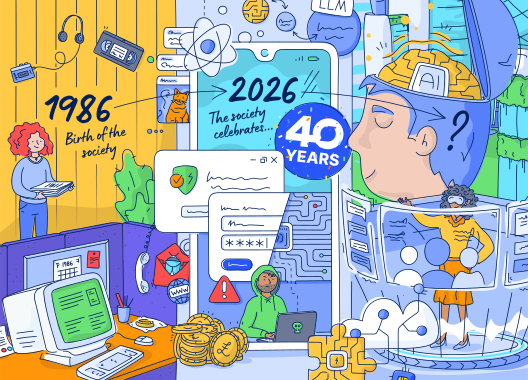
Some technology leaders have always been interested in computing. When Socitm was formed in 1986, Geoff Connell was taking a course in computer studies at Essex Institute of Higher Education. Even now, as Norfolk County Council’s director of digital and transformation and chair of the Cyber Technical Advisory Group, he remains keen: “I am into my tech as a hobby,” he says.
The year after, a 16-year-old Dylan Roberts started a youth training scheme job as an IBM PL/1 mainframe computer programmer at Clwyd County Council. “I wasn’t a very good programmer, to be honest,” he says. But he worked his way up to being a shift leader, then ran networking for local schools, then moved to Denbyshire Council as a result of local government reorganisation (LGR) where he became head of IT in 1999. Following other digital leadership roles, he is now an associate chief digital and information officer.
Sam Smith and Nadira Hussain were taking A-levels in 1986 and both took a little longer to realise their futures were in technology. For Sam, the moment came when using computers for statistical work in her degree in psychology and sociology at University of East London: “I was the one who was good at it and I realised that there was an opportunity,” she says. On graduating she got a job as a helpdesk assistant for Cambridgeshire County Council’s social services department. She rose to manage the county’s IT through a shared service then moved to the Socitm Institute as its director.
Nadira, interested in science and dentistry, took a degree in biology and nutrition at University of North London. She then worked as a microbiologist for three and half years on research and development for the food industry and became bored. “I realised that I wanted to be amongst people and that my contribution needed to deliver greater impact and make a difference,” she says. In 1994 she took a temporary job that turned permanent undertaking research for Redbridge Council’s social care department and moved into technology a few years later. She navigated a career across technology services and ran IT for the London boroughs of Tower Hamlets then Enfield before becoming Socitm’s chief executive.
Dealing with disruption
All four have seen huge changes in technology but none rate them as the most disruptive experiences of their careers. Dylan says technology provides a constant and cumulative source of disruption, but a bigger one was the shift in purpose for heads of IT in the early 2010s. “It was a move away from thinking about all the teams and the running of safe, reliable IT to changing the business model to affect better outcomes,” he says, often linked to adding the word ‘digital’ to job titles.
Both Geoff and Sam say that managing shared services was their most disruptive experience. “I learned an awful lot about relationship management,” says Geoff, who established a shared service for two London boroughs with different political leaderships. It meant looking for economies of scale and aggregation, but more importantly establishing trust and relationships: “Trust can be a fragile thing, and it can falter when relationships change because people move on,” he says. Sam, who ran a shared service covering councils in Cambridgeshire, Northamptonshire, Milton Keynes and Norwich as well as an NHS trust, says doing so meant dealing with multiple organisations in a fair, transparent and meaningful way: “That came with all of the technical issues but also all the politics as well,” she adds.
Nadira mentions email, the web and artificial intelligence (AI) as life-changing technologies but the greatest disruptions to her career came from the sponsorship of two men at different times of her career “taking a punt on somebody that they’ve seen has some potential and giving them 110% of their backing and support”. One resulted in her becoming Socitm’s chief executive: “I can’t tell you how overwhelmed and passionate I feel as being the first Asian Muslim woman heading up an organisation such as Socitm,” she says. “What an opportunity to represent who I am as a figurehead, as a role model and to really help others to see what’s possible; that where there’s a will, there’s a way.”
“I was the one who was good at [technology] and I realised that there was an opportunity”
Sam Smith, Socitm Institute
Others recall ways in which Socitm helped them. In the late 1990s Geoff joined a Socitm group focused on best value standards set by central government for local authorities, representing his head of IT. “That was a big step up for me at the time,” he recalls. “I learned so much by being with more senior colleagues from different organisations and it broadened my horizons in terms of the perspectives that I got from all those different people doing things in different environments.” He adds that Socitm lets members learn from each other, something a public sector technology leader should do whenever possible: “If ever I’ve got to do something new, the first thing I think of is do I know somebody who I rate who’s already done this? Why reinvent the wheel? This is taxpayers’ money we’re talking about,” he says.
Sam says that Socitm’s Empowering Women course in 2016 “literally changed my life,” both professionally and personally. She was chairing the society’s committee for the East of England and had wanted to take the course for a while, having been unable to join an earlier cohort. “I expected it to be good, but I hadn’t expected it to change my life,” she says. The confidence the course instilled led to her running successfully for Socitm’s presidency and starting a relationship with the man she would then marry: “I had one of those ‘feel the fear and do it anyway’ moments when I was getting ready to talk to him,” she recalls.
Building the network
The four learnt to increase their efforts to build relationships and networks as their careers progressed. “That has always been a key area of focus for me, but certainly steadily as I’ve progressed through my career into more senior leadership positions. It is something that I do with a passion,” says Nadira. This is to create connections, share learning, broaden her own thinking and also to encourage more women to follow her into leadership positions. “It also helps with diversity of personal thought, you’re questioning and challenging how you do things,” she says. Earlier in her career she says she sometimes struggled to overcome the fact that she didn’t have a technical background, but came to terms with this as she increased her knowledge, qualifications and experience within the IT environment and became a manager: “It’s the ability to demonstrate leadership qualities as opposed to hardcore technical capabilities as you become more senior, which of course you need to understand. You need the ability to create those strong teams that have the technical expertise.”
Dylan says that focusing on people is vital to anyone running a programme of technology-driven change. In the NHS, someone working to develop the technology used by an oncology department needs to understand cancer treatments as well as data science: “You can’t just have technology or data people,” he says. Sam says the big change was from doing technical work herself to managing those doing that work, from “being all about what I could do with it and what the technology was about, to understanding how to manage people in delivering that kind of stuff”.
“It’s the ability to demonstrate leadership qualities as opposed to hardcore technical capabilities as you adopt more senior roles”
Nadira Hussain, Socitm
Geoff reckons that anyone developing a career in technology is eventually faced with this choice. “You can either become deeply technical as you advance, or you can become less technical and more managerial,” he says. The former works very well for some but while he started in coding and business analysis, he moved into managing projects, client accounts, relationships and businesses. “If you want to do good things, if you want to be really impactful in terms of enabling technology and data-enabled change, you’ve got to have strong relationship management skills,” he says. Those faced with this choice should think about the impact that AI and other automation could have on their current roles and what motivates them: “It’s deciding what your personality profile is, your comfort zone, your preferences and also your level of ambition.”
The four mention different skills that have been important in their careers. Dylan says that providing coaching has been key, learning how to empower people and give them accountability to deliver rather than seeking to control everything tightly. “IT people are very left-brained, very analytical,” he says. To succeed in managing them, you need “some of those softer skills, putting the ego to one side”. Geoff learnt about the importance of managers through his first two being “chalk and cheese – the first held me back and the second one just launched me,” he says. “I would say the single most important factor in your development at work is your line manager.”
“You need to know enough not to get the wool pulled over your eyes”
Dylan Roberts
Nadira learnt to stop seeking perfection: “Anything that I did had to be done really well,” she says of her early days, limiting her capacity. “Being able to think that good enough is good enough at an earlier point in your journey means that you’re able to spread yourself better.” It would have been helpful to have greater confidence to grasp opportunities quicker and develop more commercial acumen earlier, she adds – as well as feeling able to take part in sport when she was growing up in the 1980s.
Sam says she learnt how to manage people through a well-timed diploma in management training course provided by Cambridgeshire. “I would not have been receptive to that if it had happened earlier,” she says. “I have real empathy with people who are appointed into management or team-leading roles without being given the training on how to do it, because you need it. Those are skills that you need, and you don’t just get given them, you have to learn them.”
Words of experience
Despite the importance of people skills, Dylan believes those seeking to lead local public service technology in future will still need to understand the technological foundations. “This is still a technical profession,” he says. “Even at my level you need to know enough not to get the wool pulled over your eyes.” People who both understand technology as well as possessing leadership and coaching skills will have “the dream ticket”.
Geoff emphasises the development of relationships, both outside and within your organisation: “The more you understand what other people do around you, the more you might appreciate whether that’s a career direction you would wish to take.” He adds that the current round of LGR in England will provide chances for those looking to lead, as experienced individuals like him may choose to retire rather than commit to spending several more years establishing new organisations. “I think we will not have enough people to carry out all the changes needed and there will be a lot of people leaving,” he says. “That gives an opportunity for people who are looking to develop their careers to step up.”
“I would also say be inquisitive and be constantly learning,” Geoff adds. “It’s not just in the office. I frequently say to my own kids, ‘play with AI, start doing some prompt engineering’.” Sam says that younger colleagues should understand that it is fine not to know everything. “What you need is the self-awareness to know what you don’t know and then the ability to see how you can go about fixing that.” Nadira adds that perseverance and seizing opportunities are key: “I say this to my younger son, I can do this, or if I can’t do this, I can’t do this yet. And we’ve really got to reinforce that messaging for younger people. We’ve got to enable them to fly.”
“Be inquisitive and be constantly learning… I frequently say to my own kids, ‘play with AI’”
Geoff Connell, Norfolk County Council
All four have been involved in local public sector technology for most of Socitm’s 40 years. What might things look like 40 years from now, in 2066? Dylan thinks his job will not exist and that professionals will be able to set up applications or services for themselves – something he reckons could happen in five or 10 years rather than 40. Sam wonders about the role people will play in four decades’ time: “Are people still part of the equation when it comes to delivering digital services for local government and generally?”
Geoff thinks that organisations are unlikely to have directors of IT, recalling that companies used to have directors of electricity, although they may still have people who manage transformation. He has more specific questions of 2066: “What equipment are they using to do their jobs, how is the tech enabling them to deliver their roles?” As a keen technologist he has some thoughts: “I imagine direct integration with the brain – thinking and speaking will be the user interface. The visuals may well just be overlaid straight into the brain again with no actual screens.”
Nadira thinks it is “unimaginable” how Socitm’s world might look in four decades’ time, but takes another perspective. Four decades before Socitm’s foundation, in 1946, the Second World War had just finished and Clement Atlee’s government was passing the legislation that would establish the National Health Service, sickness and unemployment benefits and universal state pensions.
“Look how far we’ve come, and yet it feels like the blink of an eye,” she says.
👉 View Socitm’s 40th anniversary timeline showing four decades of Socitm

Research view: Then, now and next for five digital trends
How cyber security, ways of working, data, artificial intelligence and digital inclusion have developed over the last 40 years and where they look set to go next.
1. Cyber security – from basic IT security to cyber resilience
Then: In the early days of IT, security in local government meant little more than locking up server rooms and installing antivirus software. This began to change as government services digitised and went online. Local governments started developing formal IT security policies and participating in information-sharing groups. A notable UK development was the creation of Warning, Advice and Reporting Point (WARP) networks in the mid-2000s, region-based communities for sharing cyber threat intelligence and good practice. The UK’s National Cyber Security Centre (NCSC) was established in 2016 – a major milestone.
Now: Today, cyber security is a top-tier management priority for every council and public sector organisation. The landscape has shifted from isolated attacks to sophisticated and persistent threats that can disrupt vital services. Recent incidents are alarming: UK local authorities have become prime targets for cyber criminals due to the sensitive data they hold and often ageing IT infrastructure. It’s now common for all council staff (not just IT) to undergo regular cyber awareness training and phishing simulations.
Next: AI-powered threats are growing exponentially, targeting networks, applications, and IoT systems. Preemptive cyber security (PCS) is one of the top 10 strategic technology trends, according to Gartner. PCS uses advanced AI-driven techniques to anticipate, disrupt and neutralise cyberattacks before they occur – moving beyond traditional detection and response.
👉 Read the full report on cyber security
2. Ways of working – from hierarchies to agile networks
Then: Back in the 1980s, the norm in councils (and most public sector organisations) was hierarchical, siloed and rigid line management. The introduction of personal computers and email in the 1990s began to break down old workflows, speeding up communications and enabling more cross-department interaction. In the 2010s, many councils adopted the private technology sector’s agile and user-centred methods then later in the decade embraced flexible working arrangements for staff in general. The catalyst that truly accelerated new ways of working was the Covid-19 pandemic in 2020. Practically overnight, many organisations had to shift thousands of employees to remote work and adapt to virtual service delivery.
Now: Pressures on public sector organisations to deliver more with limited budgets and skills shortages is generating an ever-increasing focus on leadership, collaboration, redesign and innovation. Importantly, people are now recognised as the most critical asset in digital transformation. “People-powered change” is evident in ways of working: successful organisations invest heavily in their teams’ technical and soft skills, and in diversity.
Next: Looking ahead, to address the increasing demands on public services and the impact of budget constraints, public sector organisations will need to look beyond traditional boundary constraints and foster collaboration. Technology will enable this; embrace technological advancements but also give the workforce permission to be curious, experiment and grow from experiences.
👉 Read the full report on ways of working
3. Data – from siloed records to data-driven services
Then: In 1986, the public sector certainly managed lots of information, on paper and in mainframe databases, but it was typically siloed in individual departments and used primarily for record-keeping. The late 1990s and early 2000s saw the great push to digitise: legacy paper files were converted to electronic formats and local authorities adopted enterprise databases and GIS mapping. A turning point came in the late 2000s with the open data movement while internal data integration improved gradually through data warehousing. High-profile data breaches and public concern led to stronger laws including the UK’s General Data Protection Regulation (GDPR) in 2018.
Now: Most councils rely on data analytics for policy and operations: dashboards track live service metrics such as road repairs and waste collection rates while KPI reports drive decision making in management meetings. There’s also a strong movement toward evidence-based policymaking and the use of technologies like cloud data platforms and application programming interface (APIs) make it easier to share and consume data. However, data quality and ‘single version of the truth’ issues persist.
Next: The future of data in public services should go from analysis to real action, by truly embedding data-driven practices to improve outcomes in people, communities and places. For the public sector to fully benefit from AI, organisations must build robust data foundations and scalable infrastructure.
📅 Report to be published this summer
4. Artificial intelligence – from novelty to necessity
Then: 40 years ago, artificial intelligence (AI) in the public sector was little more than science fiction. In 2016, Enfield Council became the UK’s first local authority to ‘employ’ an AI virtual agent, deploying chatbot Amelia to assist residents with routine services. Other councils brought in simple AI applications like chatbots and automated assistants but adoption was cautious, algorithms were relatively rudimentary and public sector leaders were careful to manage expectations.
Now: AI has moved from novelty to near necessity, growing significantly since 2023 due to the rise of freely available tools such as ChatGPT and Microsoft Copilot. But many public sector projects are stuck at the pilot stage, unable to scale AI solutions. Importantly, where AI is being deployed, it is amplifying human potential rather than replacing it.
Next: AI’s role in public services is expected to expand dramatically and a key emphasis will be transparency and the explainability of AI. Public sector leaders must implement robust oversight to address flawed decision-making, unregulated data use leading to privacy or security breaches and ethical violations.
📅 Report to be published this autumn
5. Digital inclusion – from bridging the access gap to closing the skills gap
Then: Ensuring everyone can benefit from technology wasn’t even a concept when Socitm was founded. In 2000, the government established thousands of UK Online Centres in libraries and community centres with internet-connected PCs and trainers to help people get online. During the Covid-19 pandemic those without internet or digital skills struggled to access education, health services and social connection.
Now: Many councils distribute refurbished laptops to disadvantaged students or provide free Wi-Fi in council housing estates. Libraries have reinvented themselves as digital hubs offering free internet access and help sessions. Most councils ensure their websites have accessibility features.
Next: As fewer people remain digitally excluded, those still offline or lacking digital skills often face multiple challenges, such as severe poverty, isolation or disabilities. Socitm expects to see more embedding of digital inclusion into frontline services, such as care workers or community health nurses checking digital connectivity needs during visits.
📅 Report to be published this autumn
This is an edited version of ‘Our focus for 2026: Five trends summary’, written by Martin Ferguson, Diana Rebaza, Yasmine Hajji and David Ogden.

Personal view: Following the data to a sustainable future
Socitm’s incoming president, Yogita Popat, on her career from policing and sports integrity to local children’s services, the environment and culture.
Following a degree in business decision sciences at Hertfordshire University, Yogita worked for Hertfordshire Constabulary, where her highlights included working on the introduction of National Intelligence Model and becoming a local intelligence manager. She then moved to the British Horseracing Authority, where she worked on investigating corruption in the sport, before setting up her own sports integrity consultancy. She joined Barnet Council in 2012.

Q. How did you start working in the public sector?
After running my own business, I realised that I don’t like working for myself, I like being in an organisation around people where I can see tangible differences every day. A data analyst role lasting six months came up in Barnet Council’s children’s and family services directorate and I thought I would give it a go; that was 14 years ago, and I haven’t looked back since!
I did multiple jobs in children’s and family services from strategy to project management to supporting the service through its improvement journey after a challenging Ofsted rating. I was focused on data, insights and using these to make evidence-based business decisions.
As we came out of the pandemic, I was offered the opportunity to set up Barnet’s insight and intelligence team, initially based in public health. I was involved in a lot of the Covid work including setting up our test and trace team and producing all of the data analytics for central government. I then worked on recovering from Covid, thinking about vulnerable residents and the impact on local communities. It was really interesting to set up a team from scratch, something I’ve always enjoyed doing.
A few years ago, a role came up which involved setting up a team to work on the council’s net zero ambitions, which I applied for and was successful. More recently my portfolio has increased and now includes our arts and culture, strategy, consultation and engagement and community participation teams.
Whilst my CV doesn’t flow like normal CVs do, my work for the police set me up for the way the public sector works, including some of the hoops and processes you have to go through. The private sector allowed me to see things from a different point of view, how you save money, work with a different mindset and bring pace into everything I do. From my police background I know that not everything can go at pace and it means I don’t get frustrated by that, whilst at the same time using the different lens to get better outcomes.
Q. What do you see as a key project in your career?
I am most proud of Barnet Council’s journey to net zero. There is a UK climate scorecard that assesses all local authorities. When we started the team in 2022 Barnet didn’t appear on the scorecards and in the recent one we think we’re going to be in the top 25% of councils in the country.
We have worked at pace and delivered some outstanding projects over the last four years including a citizens’ assembly in 2023. The assembly led to us setting up Community Energy Barnet, which is looking at putting solar panels on buildings and helping local communities to reduce their fuel bills. We also have a schools climate change strategy that supports the Department for Education’s ambitions for all schools to have climate action plans, including getting children to talk to their parents, families and friends to produce a ripple effect with small things done by lots of people.
We are also working with faith groups. A lot of faith scriptures talk about protecting the earth, nature and climate, people listen to their faith leaders and are likely to trust them. We have a very strong EcoJudaism network across the borough who are doing some really interesting things from careers fairs to faith and peace walks.
Q. What are your biggest current challenges and how are you preparing for these?
We’re no different to the rest of the sector and our financial challenges are taking up a lot of time. We recognise that we can’t just keep cutting little bits out of what we do, and so we have launched our innovation approach where we ask staff across the organisation to be part of the solution by being curious and innovative, thinking about prevention and smarter working to help deliver some of the savings we need.
We are very proud to be one of three boroughs to get a cultural impact award from the Mayor of London, along with Greenwich and Merton, to fund creative projects in 2026. We have launched Light+Flight, a borough-wide cultural programme running throughout this year. Over the summer we will launch a series of activations which will culminate in a headline project in November.
Q. How did you get involved with Socitm?
I did the Top Talent programme online during the pandemic. I then felt I needed something in-person so did the Empowering Women programme in Birmingham when we were just coming out of Covid – I think this was the only course in person at the time and I remember wearing a mask on the train. I really enjoyed these and thought the Socitm Institute approach sang to the way I work, focusing on human behaviour and empowerment. It just felt right.
I was asked to be member of the London committee, then whether I would consider being a vice-president. I have only been part of Socitm’s world for six years, but it kind of spiralled very quickly. Some of this was being asked and saying ‘sure, why not’. But as I’ve got more involved in it I have enjoyed those elements where I can steer where our sector is going and how we support it.
One of the most powerful things about Socitm is the networks you build, through courses and conferences. The power of those conversations is really important and you’re guaranteed to take away that one nugget which helps you in your day job. I have been promoting the Socitm Institute to everybody, whether they work in digital and technology, public health or work as executive assistants.
I feel excited and scared at the same time about becoming Socitm President in our 40th year. Local government is going through a huge period of change and it is exciting that Socitm can be part of this and support our members. Scared because there is so much change happening and I want to add value, also my predecessors were so brilliant I have huge shoes to fill. I want to focus on the leadership and workforce needed to navigate the changes already affecting the sector; which includes developing and growing the amazing talent we have.
Being president-elect has given me time to reflect on what I want to do in the next year. Having Kurt just before me, and Carol and Mark before that, has meant I have had the time to watch and learn without having too much responsibility. I am glad Kurt will continue to be around and Kevin hot on my heals so I won’t be all alone!
If you are thinking about putting yourself forward to join Socitm’s board, I’d say do it. It is not as scary as it seems and having a board of trustees and presidential team around you makes it so much fun but also supportive. I am always happy to have a chat with anyone who might be considering joining, as would the rest of the team.
Q. What do you enjoy doing outside work?
I love being with my family and I love reading. I read all of the time, really trashy things that require no thinking such as cosy mysteries. And I knit.
Socitm overview: How Socitm can help with local government reorganisation
Socitm is offering a range of services to English local authorities involved in local government reorganisation (LGR), to support the moves to new organisations next year and in April 2028. The current round of LGR affects more than 200 local authorities serving around 24 million people. The government will replace all the remaining county councils and lower-tier authorities with unitary councils, with the changes also involving some unitaries that border two-tier areas.
In Surrey, the county council and 11 district and borough councils will be replaced by East Surrey Council and West Surrey Council on 1 April 2027. Otherwise, day one or ‘vesting date’ for the new unitary councils will be 1 April 2028. In all these areas the existing local authorities produced multiple plans for reorganisation, with the 15 councils in Lancashire coming up with five different options that would split the area into anything from two to five unitaries.
The Ministry of Housing, Communities and Local Government announced its plans for four areas in March and is expected to decide on one option for each remaining area this summer, meaning there will be less than two years between those working in these organisations knowing the number and shape of the new authorities and their vesting date.
Andrew Rogers, an associate at Socitm, says local authorities covered by this round of LGR have been assessing their levels of readiness, their existing ICT systems and contracts and the skills and capabilities of their ICT and digital teams. Socitm is supporting several authorities in doing so.
“One of the things they are considering is should they just create a shared service that all the councils share”
Andrew Rogers, Socitm
Some are going further, with councils in Greater Lincolnshire setting up a programme in advance of the government’s decision on which of the area’s six options for reorganisation it will take forward. Socitm is working with City of Lincoln Council, which is leading the programme’s work on ICT and digital. “One of the things they are considering is should they just create a shared service that all the councils share,” says Rogers, allowing them to start setting this up before the government’s decision. “It might not be the answer but it’s one of the things they are starting to look at.”
Sharing services may make sense for those currently run by county councils whose areas are split between more than one unitary, such as social services. Meanwhile systems run by district and borough councils may need to be merged, although the new unitaries could run these systems in parallel for a time after vesting day, particularly if contracts with suppliers continue beyond April 2028.
When the government publishes its decisions for each area the affected organisations are likely to set up shadow authorities for the new unitaries, which for ICT teams means assessing their people, services, systems and data. Rogers says that shadow authorities should aim for a “minimal viable set-up” by vesting date including uninterrupted provision of safety-critical services, full protection of data and a new website to join things up.
He lives in North Yorkshire which went through LGR in 2019 and the new council’s website initially asked users to enter their postcodes as many services varied depending on the district council area they lived in. “It will take years to unravel it all and put it back together again,” he says of the LGR process.
Socitm provides support on LGR as part of membership including guidance, toolkits and networking. The Socitm Institute offers paid-for services including workshops, benchmarking, reviews and other advisory services.
Local authorities can commission smaller pieces of work such as ‘critical friend’ reports on the state of existing contracts directly when these cost less than organisation-specific limits, often £30,000. For larger commitments, such as multi-year partnership arrangements, Socitm can support local authorities in using a framework agreement or formal tender.
👉 Read Socitm’s report on LGR’s digital and technology priorities from the roundtable with partner HSO.
Local and national events
As well as our President’s Conference, we run local and national events throughout the year, in-person and online. Make the most of your membership, meet colleagues and expand your knowledge with Socitm events.

Discover all of Socitm’s events, courses, webinars and workshops
Have any feedback? Email us at hello@socitm.net