Jump to section
- Introduction: What challenges is local government facing in 2026?
- What are the key issues facing local authorities, according to DDaT leaders?
- How are councils using technology to manage or reduce costs?
- Have you seen any return on investment from recent digital initiatives?
- Where could technology improve efficiency but hasn’t yet?
- Are digital tools helping councils reach underserved communities?
- What’s been the most impactful, tech-enabled service change in your council?
- Technology direction and partner support
- Choosing and working with technology partners
- Conclusion: key insights from the workshop research

This publication has been produced with the support of HSO
Introduction: What challenges is local government facing in 2026?
Local government in 2026 is operating in one of the most challenging and fast‑moving periods in recent memory. Councils are dealing with rising demand for services, sustained financial strain and the practical realities of the largest wave of Local Government Reorganisation (LGR) since the 70s. This is reshaping how councils deliver services, manage resources and plan.
LGR is now well underway across England, with many two‑tier areas progressing towards new unitary structures. The intention is to simplify local government, reduce duplication and build financial resilience. However, the process is complex. Councils are being asked to harmonise services, integrate systems, redesign operating models and manage inherited risks, all while maintaining day‑to‑day delivery. Evidence shows that this transition is taking place at a time of heightened financial uncertainty, with some areas facing exceptional cost pressures.
Financial pressures remain a defining feature of the 2026 landscape. Councils across the UK continue to experience serious funding gaps after more than a decade of tightening budgets. Rising costs in social care, temporary accommodation, contract inflation, and workforce pressures mean many authorities are struggling to set balanced budgets. Some are requiring Exceptional Financial Support or issuing Section 114 notices.
Councils must therefore navigate rising demand with limited resources, while maintaining statutory responsibilities and ensuring financial sustainability.
Against this backdrop, 2026 represents a turning point. LGR offers an opportunity to reshape local government for the long term, but only if councils can manage the immediate financial pressures while also investing in more efficient and resilient models of service delivery. This combination of structural reform, funding constraint, and rising service demand makes 2026 a critical moment for local authorities, their partners, and the communities they serve.
Research approach and workshop overview
In February 2026, Socitm held a 90-minute online workshop with senior local government Digital, Data and Technology (DDaT) leaders to explore this evolving landscape and to understand the role of technology in responding to it.
The goal was to:
- Get a clear understanding of the major challenges and priorities local authorities expect to face in 2026 and beyond.
- Identify how local authorities are looking at technology to help address funding, efficiency, and service delivery pressures.
- Why might one tech direction be chosen over another (cost, functionality, recommendation, strategic alignment, and so on)
- Why might one partner be chosen to deliver over another? (trust, customers, credibility, awards, cost, history, recommendation, and so on)
- Explore opportunities for collaboration between local authorities
- How is this done today, and what is the best way to do it more?
What are the key issues facing local authorities, according to DDaT leaders?
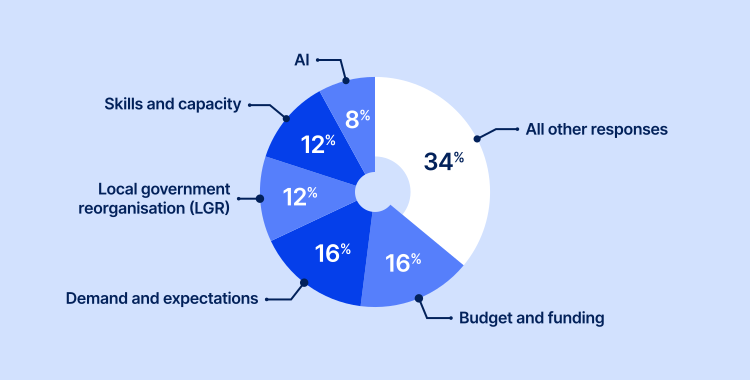
We explored some of the most pressing issues identified by participants, including funding pressures, service demand, and LGR.
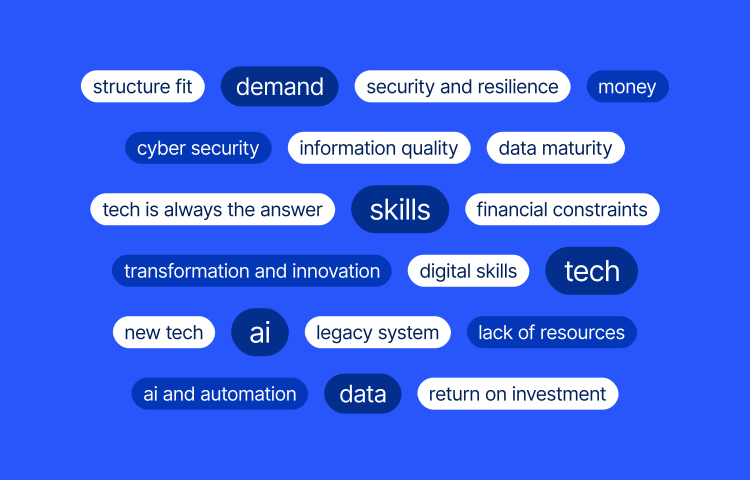
After analysing the poll results, the top five challenges were budget and funding, demands and expectations, local government reorganisation (LGR), skills and capacity and AI.
In 2026, councils are being asked to do three things at once:
- Absorb deep financial pressure
- Respond to rising demand
- Deliver LGR at pace
All without the capacity or headroom to fail.
Technology can help, but only where it is paired with simplification, stronger data, and firm governance.
How are councils using technology to manage or reduce costs?
It’s playing an increasingly important role in managing funding pressures, but with mixed results.
Some examples mentioned during the session:
- Automation is delivering real operational savings, especially where councils have been able to streamline repetitive processes. Examples included saving around £30k per automated process, with some teams achieving £100k savings when several processes were combined.
- Cloud-based tools have enabled reductions in legacy infrastructure costs too. One council saved £50k by simplifying its backup setup after moving data into Microsoft’s cloud environment (SharePoint), showing that the right shifts in technology can reduce ongoing expenditure.
- Other infrastructure changes: such as moving to Session Initiation protocol (SIP) telephony or implementing Software-Defined Wide Area Network (SD‑WAN), have also produced measurable financial benefits in the form of lower telecoms and networking costs. These kinds of improvements demonstrate that modernisation, when strategically targeted, can deliver clear cost reductions.
However, technology is far from a guaranteed cost saving tool.
In several councils, cloud migration has increased costs rather than reduced them, due to licence structures, unexpected usage fees and the need for specialist skills such as cloud engineering. Microsoft licensing and other core enterprise tools were mentioned as sources of increased financial pressure.
A notable observation was that technology can bring underlying problems to light, especially issues with data quality which then require additional costs, skills and work to fix this.
Have you seen any return on investment from recent digital initiatives?
Some examples mentioned during the session:
- One initiative with a significant return of investment (ROI) was the migration from PSTN lines into SD-WAN, delivering measurable benefits and resulting in significant, cashable savings.
- Another delivering clear ROI was the use of AI to accelerate production of Education, Health and Care Plans (EHCPs). A short-term investment in an external supplier reduced the backlog to zero and generated benefits primarily through released staff capacity, avoiding the need to recruit additional temporary resources and restoring performance to expected levels.
- An important one, but challenging to evidence, is data. Improving data quality requires investment, but it is difficult to secure funding when senior leadership don’t see an immediate, tangible return. While better data will deliver clear benefits, it can be challenging to evidence those benefits upfront.
Real, cashable savings can be achieved through structural change such as organisational redesign, consolidation and standardisation. While we are not yet culturally able to deliver this at scale, it is the direction we must take to realise sustainable benefits.
Where could technology improve efficiency but hasn’t yet?
There was an agreement that there are several areas where technology could deliver much greater efficiency, but progress is limited by deeper organisational and political issues.
Some examples mentioned during the session:
- The ambition to use technology to create open data sets, which could reduce FOI volumes and save significant staff time. This project is still in early stages but there’s a strong belief it could bring significant benefits to the organisation.
- Using AI to make decisions around Penalty Charge Notice (PCNs) was proposed by one attendee but has not happened (yet) due to uncertainty about using these tools from some elected members. Getting their buy-in is still a work in progress.
- Others highlighted that many core transactional services remain too manual. The technology to automate them exists, but some processes are still over complicated, not standardised, or simply not designed with automation in mind. As a result, technology often ends up reinforcing inefficient practices instead of improving them.
Are digital tools helping councils reach underserved communities?

There was a mixed picture here in the discussion:
- AI powered tools such as automated translation and form completion support on websites, are beginning to make services more accessible to residents with language barriers, or lower confidence in digital interactions.
- Digital inclusion: factored in digital strategy; how to educate residents on how to use AI affectively and safely. Showing residents how to interact with council’s chat bots, voice bots and so on. Working with the voluntary sector and the community digital champion for the roll out.
- AI is increasingly used by residents to generate more polished complaints or requests, which improves their ability to engage but also raises demand in ways councils may struggle to manage.
Although most citizens are learning and engaging with digital services, there is an ongoing concern for those who do not want to or do not trust it.
Overall, the conversation showed that while digital tools can improve access, councils must match them with support, training and inclusive design.
What’s been the most impactful, tech-enabled service change in your council?
Participants pointed to major platform shifts and infrastructure upgrades as the clearest examples.
Moving from outdated systems, such as Lotus Notes, to modern collaboration tools like Microsoft 365 instead, was seen as transformational (particularly during and after the Covid-19 pandemic), making hybrid working and document sharing seamless.
The biggest impacts come not from a niche tool but from large-scale modernisation efforts that reshape how people communicate, collaborate, and respond to residents.
Technology direction and partner support
When evaluating new technologies, what are your top decision factors? How do you weigh cost vs functionality when choosing a solution?
For many, functionality is the primary factor, particularly when procuring critical “tier one” systems such as social care, housing or HR platforms.
They stressed the importance of ensuring the functionality genuinely meets service needs and supports required cyber security standards. Poor interoperability, unclear vendor roadmaps, or a lack of inhouse skills to maintain a system are key reasons to reject a product.
Councils are increasingly examining support models, upgrade pathways and the vendor’s understanding of local government, rather than relying solely on technical features.
However, the conversation also made clear that cost pressures remain a strong organisational influence, even when functionality should take precedence. While practitioners often favour choosing the best fit solution, procurement rules, budget constraints and commercial pressures can push councils toward cheaper options that may not deliver long term value.
Participants described situations where focusing too heavily on cost led to systems that lacked capability, created workarounds or required expensive additional support. Others highlighted that a technically superior “Rolls-Royce” product can also be a poor choice if the council does not need or cannot fully utilise its features.
Overall, councils try to weigh cost against functionality by assessing whole life costs, including licensing, implementation, integration, support and future scalability, but acknowledged that achieving the right balance is challenging in an environment of financial strain and uneven vendor markets.
Are there technologies you’ve avoided because they didn’t fit your strategic direction?
There are some reasons why certain technologies are avoided, even when there is organisational interest or external pressure to adopt them.
- A recurring theme was platform alignment. Councils that have committed to a specific ecosystem, such as Microsoft or Google, found that many new digital products are optimised for one platform but not the other. For example: one council’s experience as a Google-based organisation meant that many Microsoft aligned tools, though functionally strong, were not fully compatible or adequately tested in their environment. Meaning implementation would be risky and costly. This misalignment often forced councils to reject products that otherwise delivered good functionality.
- The group also highlighted that lack of internal capability can be a decisive factor. If a system requires niche technical skills that the council does not have, they may avoid it to prevent long-term dependency on external consultants or spiralling maintenance costs.
- Another instance involved the discontinuation of a multi-year customisation project due to stalled progress, escalating costs, and the council’s assessment that ongoing support for the tool was unsustainable.
Participants also refrained from adopting technologies that presented strategic risks: including the potential to create operational silos, increase integration complexities, or introduce unstable support frameworks.
Overpromising from some vendors, particularly around roadmap features that do not exist or are not fully developed, undermined trust and made councils reluctant to commit to products without clear, deliverable evidence.
Procurement pressures: sometimes technologies did not fit into the long-term direction of rationalising systems, simplifying architecture or reducing fragmentation. Councils felt they had to prioritise solutions that aligned with their broader application strategy, even if it meant disappointing service areas pushing for “best-of-breed” tools.
In summary, technologies were not adopted if they didn’t align with strategic platforms, required excessive support, depended on unreliable vendor commitments, or interfered with initiatives to simplify the digital landscape.
Choosing and working with technology partners
☑️ Strong, consistent human relationships
Rather than products or marketing. What matters most is having named individuals within a supplier who are reliable, honest and genuinely invested in helping the council succeed.
☑️ Partners who listen, respond quickly, and maintain regular communication
Rather than only appearing when renewals or invoices are due. This personal continuity is especially important in a sector where many suppliers’ account managers change frequently, leaving councils feeling unsupported or forgotten.
☑️ Transparency
Noting that trust erodes quickly when partners overpromise, hide limitations, or repeatedly defer capabilities to an undefined “roadmap”. They valued suppliers who openly acknowledge what their product can and cannot do, and who provide realistic expectations from the outset.
☑️ Goodwill, fairness and shared responsibility
Showing flexibility, such as not charging for every small request, offering social value, or providing extra support during difficult transitions or high-pressure periods.
☑️ Knowledge transfer
This was seen as essential. Trust grows when suppliers help councils build internal capability instead of creating dependency – working as a team.
☑️ Good understanding of local government constraints
Especially financial pressures, procurement rules and risk appetite. Smaller vendors who engaged closely with councils and codeveloped products were often seen as more trustworthy because the relationship felt mutually beneficial rather than transactional.
In essence, trust is built when partners act as long-term collaborators showing honesty, continuity, responsiveness and a genuine commitment to improving outcomes for residents.
How do you assess value for money when comparing suppliers?
This requires going beyond basic cost comparisons and looking at the real-world experience of other councils using the same suppliers.
The formal procurement scoring frameworks such as 30/70 or 40/60 quality to cost ratios are useful but insufficient on their own.
Instead, they placed strong emphasis on speaking directly with peer authorities to obtain honest feedback on how a supplier performs once a contract is signed.
This includes:
- Understanding whether promised functionality matches reality.
- How responsive the supplier is to issues.
- Whether updates arrive on time.
- How well the product fits the complexity of local government operations.
The importance of considering whole life costs, not just initial prices was also highlighted in the discussion.
This includes licensing models, consultancy hours, hosting or cloud consumption charges, out of hours support, maintenance, integration requirements, and the hidden costs of workarounds when functionality falls short.
Others highlighted that strong service management timely updates, clear roadmaps, communication about changes, and the ability to influence product direction forms a key part of value for money because it reduces operational risk and future costs.
Ultimately, there was an agreement that value is measured not purely in pounds but in reliability, transparency, sustainability, and the long-term fit between a supplier and the council’s direction.
What kind of support do you expect from a tech partner beyond implementation?

Meaningful post-implementation support is essential for building confidence in a technology partner and ensuring long term value.
- Strong hyper care, especially during the first few weeks after going live. This includes having technical staff physically or virtually present, supporting both users and internal IT teams, and actively resolving early issues rather than leaving councils to manage alone.
- Clear visibility of their future roadmap, including planned updates, long term product direction and opportunities to influence development. Without this transparency, it becomes difficult for councils to plan strategically or justify contract extensions.
- Collaborators rather than simply vendors, value comes from partners who continually engage offering knowledge transfer, helping councils build internal capability, and ensuring they are not left dependent on costly external consultancy to operate or adapt the system. Councils expect partners to monitor and communicate changes such as updates, legislative impacts, or service disruptions, ideally with enough notice to prepare.
- Service management, including timely incident handling, structured communication and clear processes for updates and configuration changes. They appreciate partners who understand the realities of local government; this is seen as more trustworthy and easier to work with.
Simply put, councils look for ongoing partnerships rather than single projects: they value steady involvement, being responsive, sharing duties, and genuinely supporting the organisation’s growth over time.
Conclusion: key insights from the workshop research
This research shows a sector operating with little margin for error. In 2026, councils are managing sustained funding pressure and rising demand while delivering LGR transitions that require rapid service, process and systems consolidation.
Technology is an essential enabler, but it is not a shortcut: benefits come when digital investment is tightly linked to simplification, standardisation and stronger data, supported by clear governance and realistic benefits tracking.
For local authorities, the priority is to make disciplined choices that protect frontline outcomes: focus on whole life value, reduce duplication, and build the foundations process, data and capability that allow automation and AI to scale safely and fairly.
For technology partners, the opportunity is to support that reality with interoperability, transparent roadmaps, strong post implementation support and genuine capability transfer. Progress in 2026 will depend on councils and suppliers working as long term partners to deliver practical change at pace, while maintaining resilience and trust with residents.