

Get involved
If you’d like to share any thoughts and feedback, or provide case studies and resources for inclusion in Data@Socitm, we’d love to hear from you! Find out more by visiting our write for us page.

This publication has been produced with the support of Government Commercial Agency (GCA) Introduction Local government reorganisation (LGR) represents … Read more
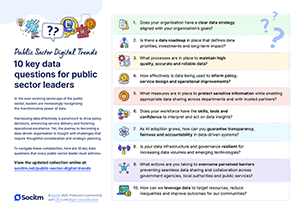
In the ever-evolving landscape of the public sector, leaders are increasingly recognising the transformative power of data. Harnessing data … Read more
Introduction In the dynamic landscape of the modern world, one phenomenon stands out as a catalyst for transformative change. … Read more

Data is playing an increasingly important role in the transformation of public services. By Leigh Dodds, Director of Advisory … Read more
Introduction Across the UK, public sector organisations spend significant time and money engaging residents. Yet many still struggle to … Read more
Introduction A data strategy sets out how an organisation governs, manages, shares and uses data. It should support strategic … Read more
If you’d like to share any thoughts and feedback, or provide case studies and resources for inclusion in Data@Socitm, we’d love to hear from you! Find out more by visiting our write for us page.

From the National Data Strategy, data is treated as:
From the public sector’s perspective, they define data by how it is used and valued.
Data is being utilised across the public sector to enhance services and inform decision-making:
The Government Digital Service (GDS) is putting the right foundations in place so the public sector can use data to deliver better services for users. Through new principles, guidance and legislation, they’re making sure data is used to its full potential, safely and ethically.
It is a collection of curated resources designed to support our members to make data driven decisions, get practical help and a deeper understanding of how you can harness data responsibly in public services.
Councils must comply with applicable laws and regulation, including UK General Data Protection Regulation (UK GDPR) and the Data (Use and Access) Act 2025 – GOV.UK apply strong governance, provide staff training and monitor systems.
Latest resources
Protecting vital public services requires public sector organisations to detect and respond to cyber threats before they can cause … Read more
Introduction Across the UK, public sector organisations spend significant time and money engaging residents. Yet many still struggle to … Read more
Introduction A data strategy sets out how an organisation governs, manages, shares and uses data. It should support strategic … Read more