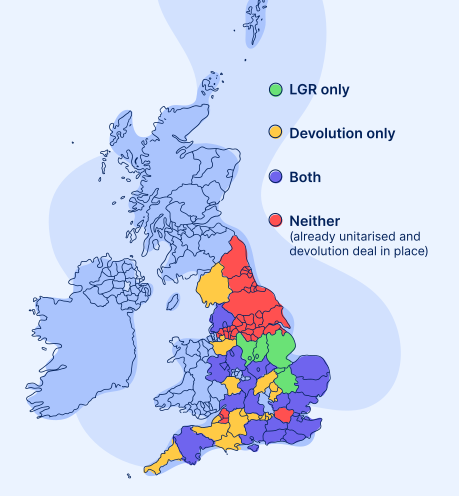
Norfolk is part of the Devolution Priority Programme (DPP). Putting them on the fast rack to mayoral devolution and local government reorganisation (LGR). It’s not just them. Cumbria, Cheshire and Warrington, Greater Essex, Hampshire and the Solent, Suffolk, Sussex and Brighton are on the list as well.
Fortunately for our Socitm local public services community, current President Kurt Frary is the Head of IT and CTO for Norfolk County Council. We get a front seat to follow his thoughts and experiences through to vesting day on 1 April 2028.
Go through it with Kurt. Connect with/follow him on LinkedIn. Not on LinkedIn? We’ll share summaries of what he’s posting.
The first key date he and his colleagues were waiting for was Wednesday 25 March. What was actually going to happen?
LGR statement from MHCLG
The results for Norfolk are:
West Norfolk Council (Breckland, King’s Lynn and West Norfolk, and 9 parishes from South Norfolk).
Greater Norwich Council (Norwich, 19 parishes from Broadland, and 16 parishes from South Norfolk).
East Norfolk Council (Broadland, Great Yarmouth, North Norfolk, and South Norfolk).
In the last few months one thing has been at the back of my mind, Local Government Reorganisation in Norfolk and the impact it would have on the region, residents, the services we deliver, and my role.
Submissions (if that’s the right word) were made to replace all councils in Norfolk with a single unitary, 2 unitary councils, or 3 unitary councils.
In my head (and on paper) the most logical answer would have been a single unitary council for all of Norfolk, this based on efficiency, joined up services and the great opportunity to focus on the best of what all of the councils in the region offer.
This [offered] the potential to both join up services and really accelerate innovation in the region.
I’ve been thinking about this a lot, planning, considering challenges we may have, meeting with suppliers and partners, talking to other councils, and working with the team talking about the positive changes coming.
This week we received the “Minded To” decision and my immediate reaction was Does Not Compute!
Having had time to digest the decision I think even though the decision is not what I was expecting or hoping for it really does still open a whole world of possibilities.
However, for now I am considering and getting my head around the need to disaggregate council services and aggregate others whilst ensuring we keep important services running and serving our residents in the region to the quality they expect.
This journey and the success of it all depends on people, good leadership and transparency and as I am one of the many people on this journey of change I thought it might be good to share as we go. To help others who are either about to embark or who will soon follow.
As the dust begins to settle following the decision on Local Government Reorganisation in Norfolk, my thoughts have turned to what this really means — and, more importantly, what needs to be done to create three new unitary councils across the region which made me think… People!
The scale of the challenge is immense, but even greater is the opportunity. This is a chance to do things differently: to build on the very best of what we already have and to design services that support people in the most effective and meaningful way possible.
This transformation will also affect the people who work across all 8 councils in the region. For many, it will open up new opportunities; for others, it will mean evolving roles, contributing to new ways of delivering services, or helping shape entirely different approaches. Change of this scale will touch my own role and the people I work with. Personally, I see significant change as something positive — something to embrace and help shape.
Of course, not everyone will feel the same. We all bring our own perspectives and experiences, and that’s natural. What I do know, however, is that successful change will depend on the amazing people across all 8 councils. By working together towards a common goal, we can turn this moment of transformation into something genuinely impactful for the communities we serve.
Dealing with the (personal) uncertainty LGR brings with it
I’ve been speaking with many colleagues about Local Government Reorganisation and doing my best to answer questions where I can. A number of common themes are emerging, including: “What happens to my role?”, “Which unitary authority will I work for?”, “What is the process?” and “When will it start?”
These are entirely natural questions—and, in truth, they’re many of the same ones I have myself.
I’ve been fortunate to have been through a number of organisational changes during my career. On the whole, these have opened up new opportunities, and I’m comfortable with change. However, I recognise that for some colleagues—particularly those earlier in their careers—this level of uncertainty can feel unsettling.
At the same time, these are also the colleagues we will be relying on to help shape and deliver the new organisation, so it’s important that we support them through this period.
I would encourage everyone to take the time to check in with one another.
We are all experiencing this change in different ways, and a simple conversation or offer of support can make a real difference as we move through this significant reorganisation.
Disaggregation and aggregation is the name of the game.
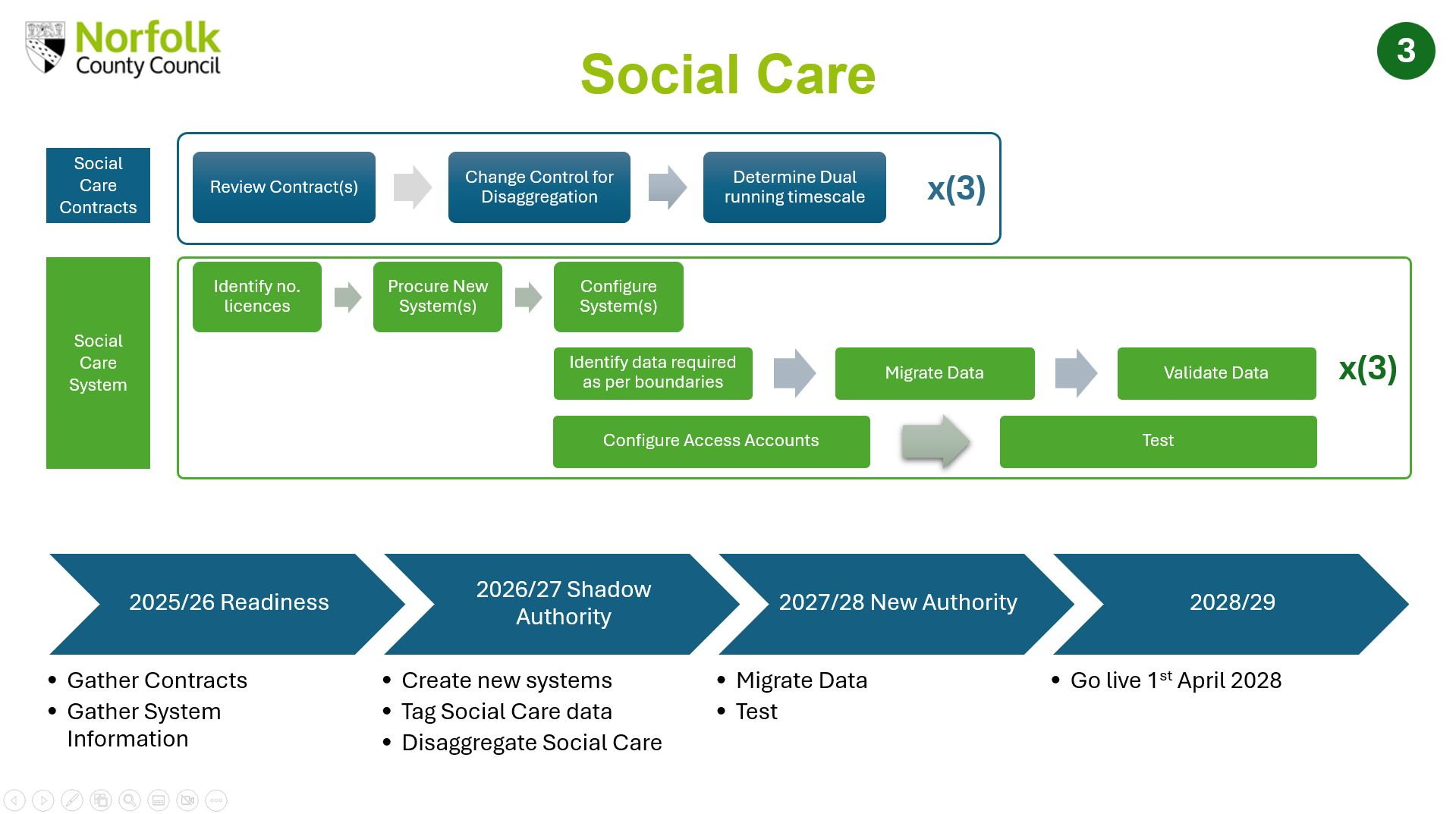
Disaggregation We will need to change the way systems and services are delivered. One major challenge is determining what to do with the technology that currently supports county-wide services such as Adult Social Care, Children’s Services, Museums, and Libraries.
Taking Adult Social Care as an example: at present, it is delivered through a single platform used across the county. In the future, this system will either need to be shared across the three new organisations, or replaced with three separate social care systems.
If we move to 3 systems, we’d need to:
Keep the existing system running to remain safe and legal
Tag all records according to the new unitary geographies
Procure three new systems, one for each organisation
Migrate the relevant records into each system
Validate all transferred data
Establish new access controls, processes, and security arrangements
Run systems in parallel for a period of time
And this is just one system.
Across the county, there are over 400 systems (depending on how you count them), in addition to all district council systems.
Aggregation Aggregation presents a different but equally significant challenge. Across the county, there are eight councils operating eight finance systems (again, depending on how you count them). We will either need to share a single system, consolidate into three new systems, or rationalise by adopting three and retiring five in a controlled manner—ensuring financial integrity, continuity of reporting, and uninterrupted payments.
These are just some of the complexities we face around Digital, Data, and Technology on the LGR journey.
A survivor’s guide to LGR: an interview with Helen Blake, Assistant Director for Customer and Digital at Westmorland and Furness Council.
LGR: Making things happen: aligning people, process and technology before the real hard yards of Local Government Reorganisation (LGR) kick in.
LGR: Get your house in order or risk paying the price. The message from the frontline is clear: local government is hurtling into transformation without a map, a shared plan, or the confidence that we’re ready for what’s ahead.
While considerable attention is often given to structures, governance and service design, successful transformation ultimately depends on people. In … Read more