Across local public services, leaders are rightly focused on demand, funding and transformation into new models of delivery.
Chief executives are managing immediate pressures. Elected members are grappling with political and financial trade-offs. Government is setting expectations for reorganisation, productivity and assurance.
But there is another issue. A less visible, less immediate, and far less comfortable one. And it’s quietly determining whether any of this is deliverable at all: the age profile of the workforce that is reshaping local government’s workforce demographics.
This is not yet a crisis. But it is a clear, evidenced risk and the window to act is narrowing fast.

The workforce risk you can no longer ignore
Local government’s staff are getting older
In digital, data and technology (DDaT) roles in particular, experience is concentrated in a relatively small cohort of people, many approaching the latter stages of their careers. Behind them, the pipeline is thin, fragmented and underpowered. A familiar pattern in local authority staffing and recruitment.
At the same time, expectations placed on councils have moved sharply in the opposite direction. A people and place-led agenda demands organisations:
- Radically modernise services
- Make intelligent use of technology and data
- Manage rising demand and risk
- Operate under sustained financial constraint
| What councils need (Demand) | Current workforce reality (Supply) |
|---|---|
| Digital‑first service redesign | Ageing DDaT workforce |
| Data‑led decision‑making | Thin early‑career talent pipeline |
| Cyber resilience | Concentration of expertise in 50–59 cohort |
| Continuous optimisation | Hard‑to‑fill DDaT roles |
👉 None of this can be achieved by treating digital as a support function or a discretionary cost.
Socitm argues that digital is not “keeping the lights on”, it’s how local government fixes its foundations. This shift requires something far more demanding than systems upgrades. It requires:
- Leadership that sets direction.
- Organisational permission for digital leaders to operate at the centre shaping the future on just responding to demand.
- Deep capability embedded throughout the organisation, not isolated at the top.

The data shows time is running out
Over the next three to five years, many councils will lose a significant proportion of their most experienced people. Very few are coming through at the same pace to replace them.
This is not speculation. It’s well signposted.
Local government has a markedly older age profile than many other sectors
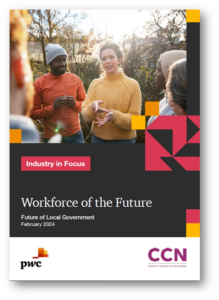
Analysis from the County Councils Network (drawing on LGA data) shows fewer than 5% of staff are under 25.
For DDaT roles, the picture is even more acute. LGA cyber, digital, data and technology workforce research shows around 40% of staff are over 50, with the largest cohort aged 50–59 and relatively low numbers under 30.
These are precisely the people councils are relying on to keep critical services secure and resilient, lead transformation programmes, assure delivery and manage risk, and translate political ambition into operational reality. When they leave, the impact will not be abstract.

Consequences of inaction
If this risk is not addressed deliberately, the consequences are predictable:
| ⚠️ Risks | 📌 What it means |
|---|---|
| Single points of failure | Loss of key staff creates fragile systems and increases operational and cyber risk. |
| Rising interim and consultancy costs | Councils become dependent on external expertise at premium rates, reducing value for money. |
| Stalled or failed transformation | Programmes slow or collapse due to lack of capability, not lack of intent. |
| Weakened assurance and oversight | Scrutiny becomes harder just as regulatory pressures increase. |
| Escalating costs and efficiency losses | Costs rise while councils struggle to demonstrate financial resilience and sustainability. |
This is not an HR issue. It’s a service and place-based sustainability issue. It’s a leadership and assurance issue. It’s a value-for-money issue. And it’s one that CEOs, politicians and government can no longer afford to treat as secondary.
Weak planning and rising exposure
Despite the scale of the risk, longer-term planning remains weak. Three-quarters of councils do not have a specific IT workforce plan, according to the LGA’s IT Capacity Survey. Recruitment is already failing to compensate.
Digital and technology roles remain among the hardest to fill across local public services, with councils across the UK reporting difficulties recruiting ICT professionals.
The deeper risk is resilience
When experienced people leave without time, space or structure to transfer knowledge, organisations lose more than headcount. They lose institutional memory, professional judgement and the informal understanding that keeps complex systems running.
At the same time, the ability to modernise services weakens, just when councils need it most.
👉 Doing nothing is not a neutral option. It simply defers decisions until they are more expensive, more constrained and more urgent.
Why this keeps happening
This explains a persistent frustration across the sector: we talk a lot about digital transformation but struggle to create the conditions for it to succeed.
Strong digital leadership does not emerge by accident. It requires:
- Deliberate, protected investment in people.
- Visible leadership pathways.
- Permission for digital leaders to operate at senior levels.
Many councils are doing positive things: apprenticeships, graduate schemes, development programmes, partnerships with universities and suppliers. But too often these efforts are small, fragmented and vulnerable to short-term budget pressure. The result is a patchwork, not a pipeline.
There is also a collective action problem. Individual councils can only do so much alone. Career pathways are narrow and progression is limited. Early-career professionals must often leave the sector to advance and many do not return.

What must change and who must act?
If the evidence points in one direction, it’s this: the workforce challenge will not fix itself.
👉 Government must recognise workforce capability as infrastructure, not overhead.

👉 Chief executives must treat digital leadership as core to organisational viability.

👉 Members must understand the long-term consequences of underinvestment, not just the short-term savings.

👉 The sector must stop trying to solve a systemic problem organisation by organisation.
It is not about commentary – it’s about leadership
These questions must be faced honestly:
- Where are the real workforce risks?
- Which roles would be hardest to replace quickly?
- Where is critical knowledge concentrated in too few people?
- Which capabilities will matter most over the next five years?
- How do we reposition DDaT roles as strategic drivers of service modernisation, not technical support functions?
This is where Socitm’s role is clear
Socitm helps councils tackle that risk head-on. We give CIOs and leadership teams practical tools, shared experience, and expert support – so services don’t depend on individuals, but on systems and teams that are built to last.
Our support is designed as a flexible menu, shaped around the challenges organisations are facing:
Strategy and direction
- Digital, data and DDaT strategy at corporate and system level
- AI strategy and governance frameworks
- Enterprise architecture and policy design
Risk, assurance and governance
- Cyber security and information governance
- Assurance and guidance for SIROs and IG leads
- Data strategy and business intelligence maturity
Transformation and place
- Operating model transformation, including product-based approaches
- Integration across health, care and wider partners
- Smart places and place-based innovation
Leadership and capability
- Executive advisory support
- Coaching and mentoring for CIOs and leadership teams
Whether the challenge is succession risk, skills gaps, or scaling capability, our focus is simple: helping organisations retain knowledge, build resilience, and sustain performance through change.
👉 The ageing workforce risk is not inevitable. But it's close enough, and clear enough, that ignoring it is no longer a responsible option.
Local government has a strong history of collaboration when it matters. This is another moment where that instinct must prevail and Socitm will lead the work to get this fixed.