Jump to section

This publication has been produced with the support of Government Commercial Agency (GCA)
Introduction
In December 2025, Socitm, the Government Commercial Agency, East Riding of Yorkshire Council and the Social Value Engine held a 90-minute virtual roundtable.
The goal was to help public sector procurement and social value professionals get more value from contracts by using clear measurement and evaluation tools. This report summarises the roundtable which covered:
- What social value means in procurement.
- A case study from East Riding of Yorkshire Council.
- An introduction to the Social Value Engine tool.
- Common challenges and suggested solutions.
The roundtable was organised after Socitm members asked for help with measuring and evaluating social value. These members had already joined sessions earlier in 2025, with local authorities and suppliers, to share perspectives on delivering social value in procurement in light of the Procurement Act 2023 coming into force.
All comments are summarised to keep participants anonymous.
1. Overview of social value in procurement
Social value is what is added to a procurement contract above and beyond the standard requirements. Under the Public Services (Social Value) Act 2012, the public sector must consider how procurement can improve economic, social and environmental conditions.
Examples of securing social value through procurement include:
- Creating jobs, apprenticeships and volunteering opportunities.
- Delivering training.
- Utilising small-medium enterprises (SMEs) and voluntary, community and social enterprises (VCSEs) in supply chains.
- Carbon reduction and sustainability initiatives.
- Diversity and inclusion initiatives and support for disadvantaged groups.
The aim of social value in procurement is to promote mature and ethical market capitalism, alongside sustainable growth and better outcomes for buyers.
1.1. Key laws and guidance
Further relevant social value laws, policy and associated guidance for public sector buyers to follow, to establish clear criteria for social value within their procurement processes include:
- Procurement Policy Note (PPN) 06/20: Social value in the award of central government contracts.
- Procurement Policy Note (PPN) 06/21: National Procurement Policy Statement (NPPS).
- Procurement Policy Note (PPN002) 02/25: Taking account of social value in the award of contracts.
- Procurement Act 2023: Contracting authorities must have regard to the NPPS.
1.2. Social value delivery
The two key principles for delivering social value are:
- Additionality – Social value should add benefits beyond the core deliverables. It should not just repeat corporate social responsibility (CSR) activities.
- Relevancy – Social value commitments must be relevant and proportionate to a contract’s primary purpose.
To achieve additionality and relevancy, it is recommended that buyers and suppliers engage early in the procurement process to identify meaningful deliverables for social value. Ongoing collaboration between the two will ensure supplier capabilities land with the specific needs of the community.
1.3. Measuring and evaluating social value
To deliver meaningful social value, it is crucial for public sector buyers and suppliers to measure and evaluate the impact of deliverables. This ensures that commitments translate into useful and relevant benefits for communities and that the intended outcomes are achieved.
1.3.1. Steps for public sector buyers
To measure social value effectively, public sector buyers should:
- Identify the desired outcomes they wish to achieve through procurement.
- Determine appropriate award criteria and assign clear weighting to social value elements.
- Assess supplier readiness and identify relevant contact points for monitoring and engagement.
- Follow relevant frameworks to ensure a consistent and robust approach to social value measurement.
1.3.2. Expectations for suppliers
Suppliers must also make clear commitments to ensure that social value is effectively integrated into contract delivery. Their proposals should set out how they intend to achieve and evidence the outcomes specified by the buyer.
1.3.3. Evaluating supplier commitments
Public sector buyers should evaluate supplier commitments based on the proposed impact of the social value that is offered, focusing on the quality and significance of outcomes, rather than just considering the quantity or type of actions promised.
1.3.4. Key considerations for measuring social value
Buyers and suppliers should decide the following to ensure the visibility and reportability of supplier-delivered solutions:
- Whether to use quantitative or qualitative data in reporting impact.
- Which methodology is most appropriate for measuring social value in the context of the contract.
- Which metrics will best capture the intended outcomes and demonstrate value.
- Whether to focus on short-term delivery or long-term outcomes that create lasting change.
👉 Interested in finding out more about public sector procurement? Visit the Crown Commercial Service website.
2. East Riding of Yorkshire Council’s approach to social value

How can a public sector buyer maximise social value in procurement and measure social value delivery effectively?
East Riding of Yorkshire Council’s five-year journey to embedding social value in not just procurement but also across the whole organisation has evolved considerably. This has included an overhaul of social value guidance, the creation of a dedicated social value board, and the development of robust processes including the use of the Social Value Engine (which East Riding co-created) to ensure meaningful, measurable outcomes for the community they serve.
The council shifted from generic, tokenistic commitments to a needs-based approach. To do this, they held workshops with VCSE partners such as food banks and internal colleagues, to explain social value, to gain a deeper understanding of community requirements and to better align supplier offers accordingly.
Supplier and internal guidance were also revised, with a focus on narrowing down to key performance indicators and clarifying expectations. This enabled more effective scoring and selection of social value commitments within tenders which previously were impossible to score due to unclear guidance.
In terms of the percentage split for social value, East Riding have a 10% social value weighting for tenders:
- 5% qualitative weighting – Suppliers must provide a delivery model to achieve what has been proposed with detail around timescales, who, where, what, when and how.
- 5% quantitative weighting – The impact that has been generated or potentially will be generated. The council use the Social Value Engine to score this.
East Riding also give its suppliers autonomy to come up with solutions by proposing what they would like to achieve and letting the supplier come up with suggestions the council may not thought of.
Once the contract has been awarded, and the social value has been committed by the supplier, East Riding use the Social Value Engine to monitor this. To do that, they add their commitments into the Engine to produce a spreadsheet that can be then sent to the supplier to monitor supplier commitments and facilitate regular reporting to ask them to give updates on commitment delivery.
In terms of next steps, the council is currently reviewing its social value policy which was written in 2023 to ensure alignment with the latest developments and drafting comprehensive guidance to administer to all stakeholders.
👉 Interested in finding out more? Contact Jennifer Jefferson, Social Impact Coordinator at East Riding of Yorkshire Council - jennifer.jefferson@eastriding.gov.uk.
3. Social Value Engine: Measurement and evaluation tool

The Social Value Engine is a digital platform co-developed with East Riding of Yorkshire Council, designed to help organisations measure, evidence, and report social value in a consistent and transparent manner.
Accredited by Social Value International, the Social Value Engine adheres to international standards. It is widely used by public sector and VCSE organisations across the UK because it supports and aligns with local and regional priorities.
The Social Value Engine makes impact reporting fast, easy to use and meaningful. It enables procurement teams to focus on outcomes rather than outputs by tackling the following challenges:
- Complexity of translating contract deliverables into measurable social value.
- Time pressures mean it is not feasible to spend weeks setting up measurement frameworks or ‘chase suppliers’ for commitments.
- Consistency issues caused by different suppliers and different approaches.
3.1. How does it work?
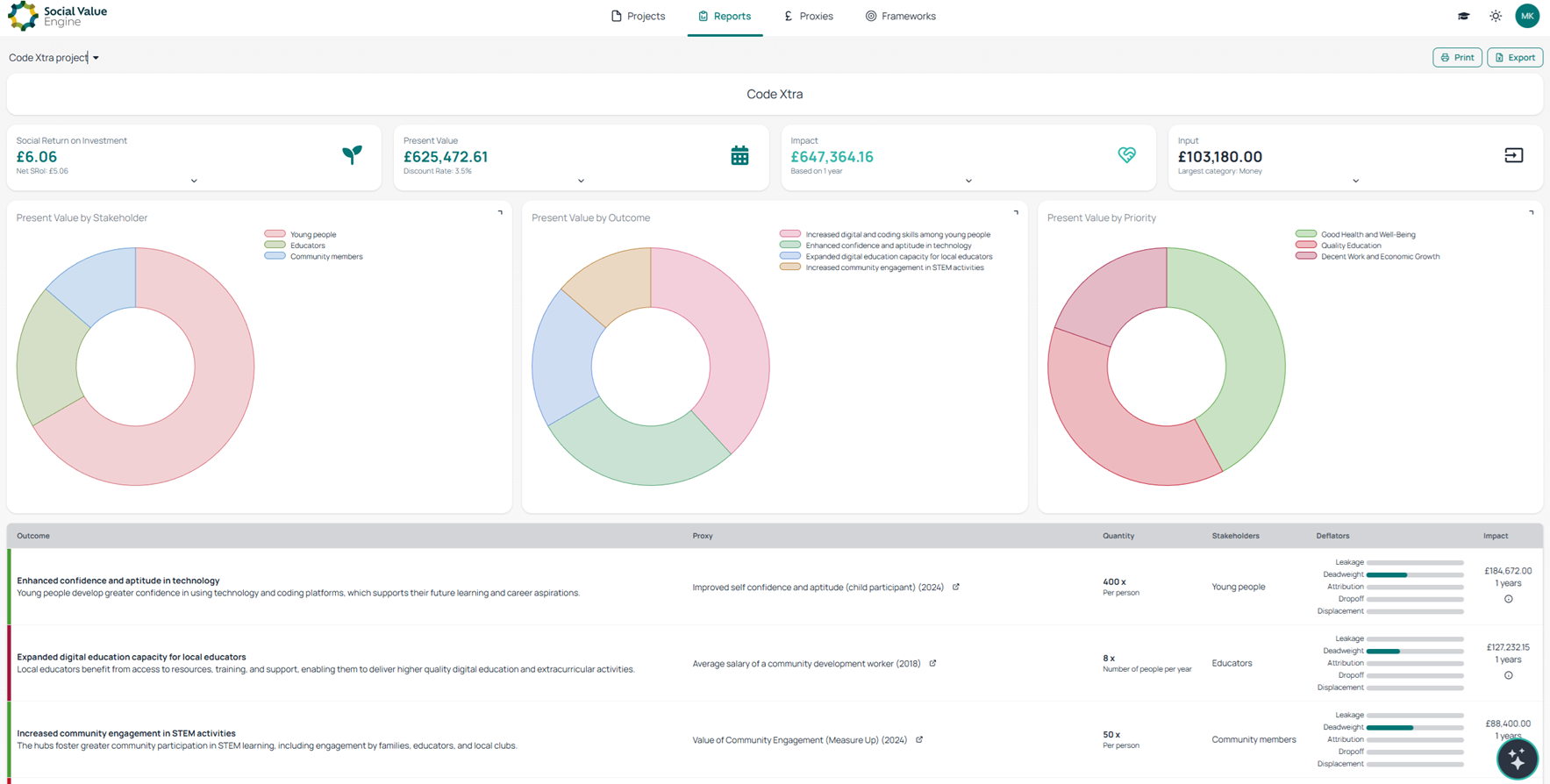
The platform allows users to set up projects, select outcomes and stakeholders, and utilise AI-assisted tools to streamline reporting. AI assisted impact reporting significantly reduces time and resource required to set up new projects. The AI functionality is trained by social value consultants, not using user data. This provides intelligent outcomes, stakeholder and proxy suggestions.
The focus is on measuring outcomes rather than outputs, with more than 650+ curated financial proxies that tie your outcomes to social value metrics. The proxies are actively curated, expanded and maintained and aligned with framework of choice.
Transparent reporting is supported through links to data sources and regional dashboards for tracking impact.
The tool can be customised to create location-specific proxies, including those related to environmental benefits, and incorporates AI functionality to assist in identifying relevant metrics.
3.1.1. Three steps: tender, template, report
- Set up project with defined stakeholders and outcomes in the Social Value Engine.
- Export as spreadsheet template and attach spreadsheet to ITT for suppliers to fill out.
- Drag and drop into the Social Value Engine for immediate calculation of Social Return on Investment (SROI) for impact comparisons.
3.1.2. The report
The report can be project, programme or regional level and includes:
- Social return on investment.
- Full social impact.
- Outcomes distribution.
- Stakeholder distribution.
- Framework alignment.
- Detailed outcome information with link to supporting proxy research.
👉 Interested in finding out more? Contact Maddie Kortenaar, Marketing Director at Social Value Engine - maddie@socialvalueengine.com.
4. Discussion: Challenges and suggested solutions in measuring social value
After receiving an overview of social value principles, a case study of social value delivery at East Riding Council and an introduction to the Social Value Engine, public sector procurement and social value professionals discussed several common challenges and suggested solutions with measuring social value.
4.1. Vagueness and undefined measures
Challenge: Initial difficulties often arise due to vague or unmeasurable social value commitments often because buyers do not ask for specific deliverables which invites vague measures.
Solution: There is a clear need for guidance, well-defined outcomes, and a balance between prescriptive requirements and supplier autonomy.
4.2. Technology procurement challenges
Challenge: It is difficult to extract meaningful social value from technology contracts since suppliers are rarely local to the councils they serve.
Solution: East Riding council asks suppliers how they can meet local outcomes and informs them that scoring is based on this.
Challenge: It is challenging when suppliers decide what to deliver without knowing a community’s needs.
Solution: Develop a catalogue of project examples that an IT supplier might support. Suppliers could help deliver digital upskilling programs for either public sector employees or members of local communities.
4.3 Lessons from Northern Ireland
Since 2017, technology contracts in Northern Ireland have incorporated a wide scope of social value initiatives – employment opportunities, work placements, digital inclusion, support for social enterprises, supply chain enhancements, and more.
However, several important factors have contributed to effective and impactful delivery of social value.
- Co-designing social value approaches with the tech sector which meets the balance of being specific and getting tangible outcomes without hampering innovation.
- Presenting a menu of options backed by contract clauses that establish clear quality standards and scope, making sure during the bidding stage that the supplier specifies exactly what will be delivered and provides a delivery schedule.
- Establishing a brokerage database for suppliers which lists all social enterprises, community organisations and more, to facilitate partnerships between suppliers and the community. Suppliers can also use this resource at bidding stage, post award and delivery.
Northern Ireland has also developed several initiatives specific for ICT, including digital skills training, donation of ICT devices, donation of software or licences to VCSEs and financial support for ICT qualifications to people who are furthest from the labour market.
More advice and support for procurement teams on social value can be accessed at Procurement – Social Value NI, which features:
- Model social value text for inclusion in procurement documents points approach for IT contracts.
- Training sessions for public sector in NI on a quarterly basis on how to embed social value throughout the contract lifecycle.
4.4 Supporting suppliers with social value delivery
Challenge: How can councils help suppliers deliver meaningful social value? Councils often lack resources to provide support, such as organising activities or negotiating contracts. It is also unclear whether the supplier or council should take the lead.
East Riding gave the example of a supplier who offered 50 school workshops on digital inclusion and employability but faced low uptake from schools. The council intervened to identify barriers to take-up by consulting with the schools.
Solutions:
- Councils should provide signposting and support but not assume responsibility for organisational delivery.
- Suppliers who include detailed delivery plans in tenders can help address such timing issues, as well as clarify what resources suppliers have to fulfil their commitments.
- Councils that lack dedicated social value coordinators tend to face these challenges more frequently, whereas having such a role alongside contract managers provides essential support for suppliers. Often, councils only have procurement staff available and do not have someone specifically responsible for social value.
4.5. G-Cloud 15 and national frameworks
The discussion also covered how social value measurement might change when using national frameworks like G-Cloud 15, especially regarding councils’ and suppliers’ approaches. The Crown Commercial Service is still assessing the impact. G-Cloud 15 aims to improve visibility of supplier social value offers and enhance how social value is added and measured in national frameworks.
4.6. Balancing environmental impact in social value delivery
Finally, how to approach environmental quality within contracts was discussed and the efforts being made by some councils to separate and appropriately weight environmental and social value criteria in procurement.
Certain councils are trialling environmental impact assessments to ensure that the environmental effects of a contract or service are evaluated as early as possible. Others are modifying social value scoring to place greater emphasis on the added environmental impact.
There is ongoing consideration as to whether councils should make environmental requirements like setting net zero targets or decarbonising supply chains mandatory in contracts.
Recommendations
- Embed social value early: Integrate social value considerations at the earliest stages of procurement planning. Engage with suppliers and stakeholders to identify relevant, community-focused outcomes before contracts are drafted.
- Use clear, measurable criteria: Develop and apply clear, outcome-based criteria for social value in tenders. Avoid vague or generic commitments by specifying what is expected and how it will be measured.
- Adopt robust measurement tools: Utilise digital platforms such as the Social Value Engine to ensure consistent, transparent, and efficient measurement and reporting of social value outcomes.
- Balance qualitative and quantitative assessment: Combine both qualitative and quantitative metrics in evaluating supplier proposals and monitoring delivery.
- Support supplier delivery: Provide guidance and signposting to help suppliers deliver on social value commitments but clarify roles to avoid overburdening with delivery responsibilities.
- Foster collaboration and co-design: Work with suppliers, community organisations, and sector partners to co-design social value initiatives that are both innovative and aligned with local needs.
- Regularly review and update policies: Continuously review social value policies including environmental quality and guidance to reflect legislative changes, best practices, and lessons learned from implementation.
Conclusion
Maximising social value in procurement requires clear guidance, early collaboration, and robust measurement tools. The roundtable highlighted that success depends on moving beyond generic commitments to focus on outcomes that genuinely benefit communities. Practical frameworks, digital platforms like the Social Value Engine, and lessons from public sector case studies all support more transparent, consistent, and impactful delivery.
Ongoing improvement and partnership between buyers and suppliers are essential to ensure procurement delivers lasting social value. To do this, buyers must structure procurement processes to ensure that impacts and benefits are transparent, measurable, and reportable, with clear contractual obligations requiring suppliers to provide regular reporting.
Useful links
- Social value (Government Commercial Agency)
- G-Cloud 15 supplier information video on social value (Government Commercial Agency)
- Social value (East Riding of Yorkshire Council)
- Preparing for the new Procurement Act 2023 (Socitm)
- Procurement and social value: Supplier and local authority perspectives (Socitm)
- Social Value Engine, the UK’s only accredited social value platform (Social Value Engine)
- Social value – Integrating social benefits into public contracts (Strategic Investment Board)