Jump to section
- Introduction
- Key findings: What makes LGR successful (contracts, data, cyber and suppliers)
- Detailed findings: Data, collaboration, supplier risk and cyber security
- Contract data quality and visibility
- Collaboration and standardisation in ICT
- Supplier capacity and market risk
- Digital and cyber security risks during LGR
- Planning beyond vesting day
- Peer learning and sector support
- Conclusion

This publication has been produced with the support of Government Commercial Agency (GCA)
Introduction
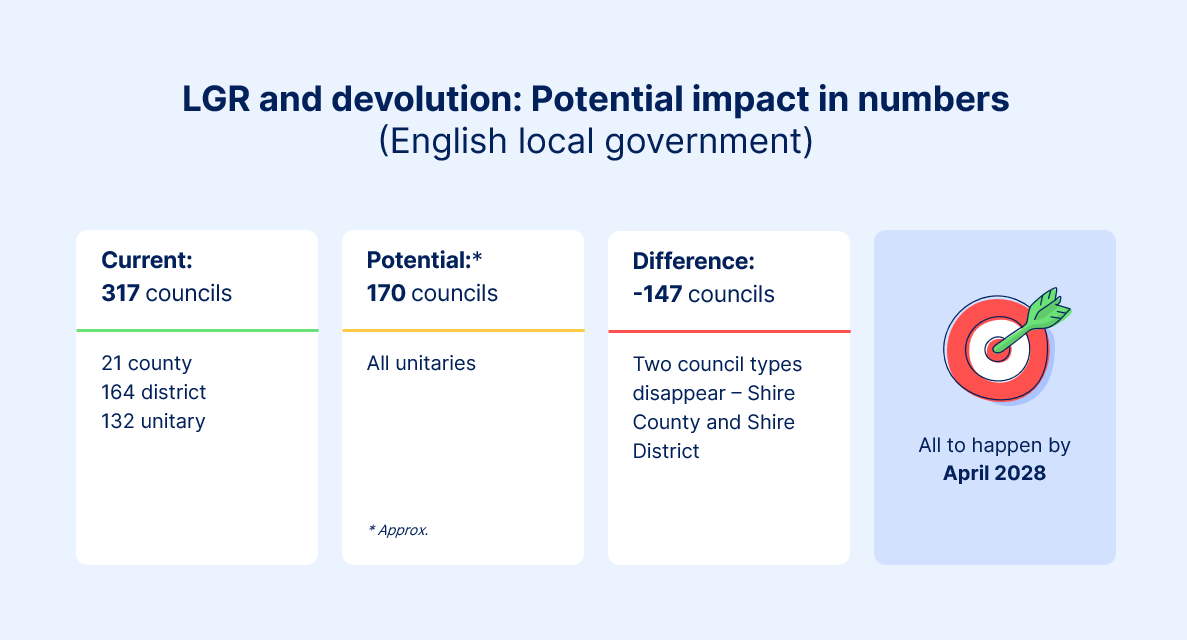
Local government reorganisation (LGR) represents one of the most significant structural changes to local government in England for over fifty years. The scale and pace of the current programme present councils with complex operational, commercial, digital, and organisational challenges. In this context, the “Making LGR work for you” workshop brought together local government practitioners, central government representatives, and sector bodies to explore how councils can better manage procurement, contracts, digital, data and cyber risks during transition.
The workshop focused particularly on contracts management and data quality in preparation for vesting day. Presentations were delivered by representatives from Government Commercial Agency (GCA) – formerly Crown Commercial Service, and MHCLG’s Local Digital team, followed by an extended discussion with practitioners from councils at different stages of the LGR journey.
The session aimed to surface practical insights, shared risks, and opportunities for collaboration, as well as identifying where further sector and central support is needed.
This report summarises the key themes, findings, and implications from the workshop discussion, drawing directly from the recorded contributions of speakers and participants.
Key findings: What makes LGR successful (contracts, data, cyber and suppliers)
The scale of LGR
c.£44Bn of total supplier spend per annum (2024/2025) *
Source: Oxygen Finance insights data
In a county area, LGR will lead to complex aggregation and disaggregation of resources of all types – money, assets, debt, people, technology, contracts – all requiring considerable expertise and capacity. That means valuing, building and developing those skills in our organisations.
Nicole Wood, Chief Executive, Essex County Council
Findings
Overall, the discussion reinforced that LGR is not solely a structural or political exercise, but a complex commercial and digital transformation challenge requiring early action, collaboration, and clearer guidance.


Detailed findings: Data, collaboration, supplier risk and cyber security
Why contract management matters in LGR
A central theme of the workshop was the importance of contracts in enabling or constraining successful reorganisation. CCS analysis across multiple LGR areas demonstrated the sheer scale of contractual complexity, with county areas holding on average around 5,000 contracts, involving tens of thousands of suppliers and billions of pounds of spend. This scale alone makes contract management a strategic issue rather than an administrative one.
Evidence from the National contract management survey conducted in February 2026, showed that contract management often lacks sufficient senior attention.
Some of the highlights:
- Do you think contract management is given the required attention by Senior Management?
Only 30% consider contract management to be taken seriously - Are you able to identify cashable and non-cashable savings from improved contract management over the last 2 years?
Almost half of councils (47%) were unable to answer this question. There was no way to measure or track their contract management process to identify savings. - As a %, how much financial value is lost due to poor contract management based on an average per contract through direct and indirect costs
Mean response 20% loss of the value
In the context of LGR, this presents both a risk and an opportunity. Poorly understood contracts can delay integration, increase costs, and expose councils to legal or operational failure.
Contract data quality and visibility
Data is the starting point. Proper analysis of contracts across LGR areas is enabled when data is consistent, as complete as possible, and available in a usable format. Only then can councils identify common suppliers, determine contract end dates, and understand any risks associated with contracts extending beyond vesting day.
Participants acknowledged that maintaining robust contract registers has historically been a weakness in local government, often due to limited capacity and fragmented ownership across services. The workshop reinforced the message that councils should prioritise improving contract data early, even before formal LGR decisions are confirmed, as this work underpins all later decisions.
Collaboration and standardisation in ICT
Interestedly, GCA found that whilst most ICT contracts are for software, these contracts make up a smaller proportion of total ICT spending. Meaning, there are lots of small software contracts and managing them takes time and effort.
Many of the same suppliers work with different counties, which shows that there is potential for aggregation and collaboration.
Participants broadly agreed that LGR creates a unique opportunity to rethink long‑standing procurement practices. However, there was also recognition that collaboration is difficult in practice:
- Misaligned contract end dates
- Differing local priorities
- Uncertainty about future structures
These can all slow progress.
They challenged the idea that contract length is a genuine barrier, noting that most contracts are relatively short and could be aligned with sufficient intent (very few contracts exceed 3 years in length).
Q: Given fewer resources in the sector, will standardisation become a preferred choice since it simplifies the specification process for contracting authorities?
Standardisation is a tricky but important subject. With reduced capacity, fewer councils, and tight LGR timelines, standardised approaches help councils deliver reliably and at pace, particularly for common or commodity services. However, standardisation must be balanced with local needs. Some services and contexts require local variation.
The challenge is agreeing where consistency adds value and where flexibility is genuinely needed.
Supplier capacity and market risk
A significant concern was supplier capacity. With many councils reorganising at similar timelines, demand for the same suppliers is likely to peak simultaneously. This creates a risk that suppliers may struggle to support migrations, integrations, and contract changes at scale?
Participants discussed whether councils should act not only within county areas but across wider regions to mitigate this risk. There was recognition that individual councils often lack the leverage to influence supplier behaviour, reinforcing the case for collective action and stronger central support.
Digital and cyber security risks during LGR
Cyber security featured strongly in the discussion, particularly given the timing of vesting day and the level of organisational change involved. The risk of cyber incidents increases during periods of transition, when systems, roles, and responsibilities are changing.
Security Operations Centre (SOC) was framed as a system‑level issue rather than an individual council issue.
Q: Why have shared or aggregated SOC models for local government not progressed, despite being a common and resource‑intensive requirement?
Standing up a national SOC is not feasible for us at this time. The scale, resourcing, technical requirements and budget needed would not provide the best return for the sector. Instead, Local Digital is focusing efforts where we can deliver the greatest value: strengthening our Cyber Incident Response service (CIR) offer and improving how we share intelligence with councils.
Find our more about our CIR service.
Work is underway to develop a practical guidance pack to support councils in understanding and procuring SOC services.
Local Digital team (MHCLG)
Some practical examples were shared of councils partnering with health organisations to achieve the scale needed for SOC provision, suggesting that cross‑sector models can work where local government alone lacks sufficient scale.
Planning beyond vesting day
Participants with experience of previous reorganisations stressed the importance of planning beyond vesting day. While “safe and legal” day‑one operation is essential, many of the most challenging integration tasks occur afterwards. This includes system consolidation, workforce induction, contract rationalisation, and service redesign.
Insights from councils such as North Yorkshire highlighted the need to treat staff as effectively “new starters”, with clear induction, training, and communication. Aligning priorities across HR, finance, procurement, IT, and services was described as one of the most difficult aspects of reorganisation.
Peer learning and sector support
Finally, the workshop underscored the value of peer learning. Participants repeatedly referenced the benefits of speaking directly to councils that have already undergone LGR, sharing templates, contract clauses, supplier communications, and lessons learned.
While informal peer learning was seen as extremely valuable but inconsistent and reliant on personal networks, there was strong support for more structured mechanisms, facilitated by Socitm, CGA and MHCLG, to capture and share this experience.
Conclusion
The workshop demonstrated that LGR is as much a commercial, digital and organisational challenge as it is structural. Contracts, data, technology and cyber sit at the heart of successful transition, yet are often constrained by limited capacity, fragmented ownership and market pressures.
There are opportunities for councils to:
- act early
- improve data quality
- collaborate more effectively
- learn from those who have gone before
At the same time, it exposed unresolved issues, particularly around supplier capacity, cyber security, and shared services, where further central and sector leadership is needed.
In conclusion, the workshop reinforced that making LGR work requires sustained focus beyond vesting day, stronger collaboration across boundaries and a shared commitment to turning reorganisation into a platform for long‑term improvement rather than short‑term survival.