Jump to section
A look back
Artificial intelligence (AI) has developed through several overlapping phases, beginning with systems based on predefined rules. Machine learning models identified patterns in data, while generative models created new content. Today, emerging agentic systems can now plan and perform defined tasks.
The timeline below shows how AI has developed in the public sector. It also traces the shift from automating specific tasks to generating content and coordinating more complex workflows. As capabilities expand, the need for reliable data, clear accountability, appropriate controls and human oversight also grows.
From expert systems to agentic AI
Four decades of change in public sector work
AI as rules
• Expert systems codify rules from human experts
• Automate routine decisions in narrow domains
• Improve consistency and reduce errors
AI as learning
• Machine learning finds patterns in data
• Models improve with more data and feedback
• Better predictions support data-informed decisions
AI as perception
• Al perceives images, text, speech and signals
• Extracts meaning and understands context
• Enables real-time insights at scale
AI as generation and action
• Al generates content, recommendations and plans
• Agents take actions across systems and workflows
• Supports adaptive, outcome-driven public services
Then: Rule-based automation
Systems followed predefined rules to automate specific tasks and improve efficiency.
Now: AI-powered insights
Al learns from data and perceives the world to inform better decisions and deliver value.
Next: Agentic AI at work
Al acts on our behalf, adapts to change and orchestrates outcomes across the public sector.
*Please note: a PDF file is not the most accessible option for people with visual impairments. We suggest using PDFs for print purposes only.
A leap forward
Artificial intelligence (AI) is becoming part of everyday work across local government. It offers opportunities to improve productivity, strengthen services and make better use of limited resources. Realising those benefits safely depends on clear governance, organisational readiness, practical support and continued public trust.
Understanding the AI landscape
AI refers to technologies that can perform tasks normally associated with human intelligence, such as recognising patterns, making predictions, generating content or supporting decisions.
Generative AI is a type of AI that can create new text, images, code, summaries or other outputs in response to prompts. It can help organisations streamline workloads, simplify complex tasks and support service improvement. Its outputs can also be inaccurate, incomplete or biased, and its use can create risks relating to data protection, cyber security, intellectual property, discrimination, environmental impact and over-reliance on automated outputs.
Agentic AI describes systems that can pursue goals, plan steps and take actions with varying levels of autonomy. This creates further questions about accountability, integration, data quality, monitoring and human oversight.
Different AI technologies and uses create different opportunities, risks and assurance requirements. Organisations should therefore apply controls that reflect the proposed use, the people who may be affected and the potential consequences, rather than treating every AI application in the same way.
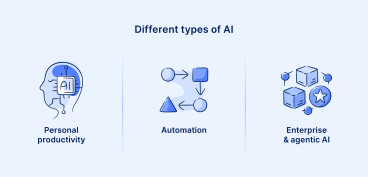
- Personal productivity: tools such as Copilot or ChatGPT can help individuals draft, summarise and analyse content. They can be introduced quickly, but their use and benefits may be difficult to measure consistently. Approved tools and clear guidance can also reduce ungoverned or “shadow” use.
- Automation: workflow and document-processing tools can support defined processes. Benefits may be easier to estimate where transaction volumes and handling times are known, but successful implementation usually depends on process redesign as well as technology. Rules-based automation is not necessarily AI and should be described accurately.
- Enterprise AI: AI systems integrated with organisational services, data and technology can support wider service redesign. Agentic AI is a more specific category in which systems can plan or take actions in pursuit of defined goals, requiring clear boundaries, monitoring and accountability.
AI adoption in UK local government
AI use is established across much of local government. The Local Government Association’s state of the sector survey found that 90 to 95% of responding English councils were using or exploring AI. This figure describes activity among survey respondents, not readiness to scale AI or evidence of realised benefits.
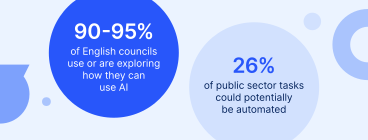
Separately, modelling cited by the Tony Blair Institute suggests that around 26% of tasks across the wider public sector could potentially be automated. This estimate is wider in scope than local government and should not be read as a forecast of job losses, savings or benefits.
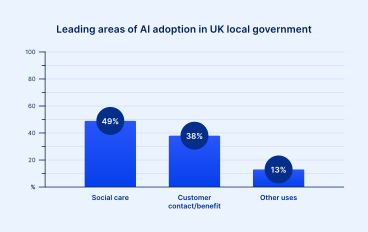
Adoption is not evenly spread across services. Social care, customer contact and benefits are among the areas in which councils are using or exploring AI (see chart below). These high-demand services may offer opportunities to improve access, reduce administrative work and support staff, but they also require careful consideration of accuracy, equality, transparency and human oversight.
Adoption is not the same as readiness
High levels of experimentation do not necessarily mean that councils are ready to scale AI. Adoption describes whether AI is being explored or used. Readiness describes whether an organisation has the governance, skills, data, technology and capacity needed to use it safely and consistently. Maturity is reflected in how reliably these capabilities operate across the organisation.
Public sector procurement of AI technologies is also increasing. By early August 2026, AI-related public sector contracts had reached a combined value of £1.41bn across 453 contracts. However, spending and contract activity do not demonstrate that organisations are equally ready to implement or scale AI safely. Many organisations remain focused on pilots or early expansion and face common constraints relating to data quality, legacy technology, governance, skills and capacity.
The GoLLM and Heriot-Watt University assessment of 208 UK local authorities identifies institutional barriers as well as technical ones, including governance, skills, usable data foundations, legacy technology and the capacity to scale safely. Research from the Local Policy Innovation Partnership Hub similarly reports growing use of large language model tools, chatbots, predictive analytics and efficiency-focused applications, alongside mixed evidence of benefits and continuing capability, procurement and governance challenges.
Access to tools is therefore only one part of readiness. Councils also need organisational conditions that allow promising use cases to be tested, approved, monitored and repeated safely.
What responsible scaling requires
Effective governance should make responsible innovation easier, not create control for its own sake.
This requires senior leadership, service ownership, information governance, data protection, cyber security, procurement, legal advice and equality considerations to be connected throughout the lifecycle of an AI system.
Responsibility remains with the organisation throughout the AI lifecycle, even where a tool generates content, makes recommendations or carries out actions. Human oversight should be meaningful, with clear authority to question, change or stop the use of a system.
How Socitm supports responsible adoption
Socitm supports members and the wider public sector to understand, govern and adopt AI in safe, responsible and practical ways. Digital, data and technology (DDaT) professionals can use AI@Socitm, peer-reviewed guidance and templates, case studies, webinars, leadership development, benchmarking, regional forums and partner roundtables to inform business cases, compare approaches and create a shared basis for conversations with service leaders and corporate specialists.
The Digital Trends 2026 AI theme builds on this support, with a particular focus on GenAI because it is already accessible to staff, suppliers and residents and is spreading quickly across services.
The material brings together practical insight, shared learning and sector examples to help members consider where generative AI may add value and where stronger oversight is needed. Further material is available through AI@Socitm.
Putting responsible AI into practice
Socitm has developed the generative AI assessment checklists to help close that practical gap.
The assessment checklists provide a structured way to assess risk, ethics, procurement and continuing assurance before generative AI tools are adopted or scaled. They complement, rather than replace, local governance by prompting questions about public value, accountability, transparency, data protection, security, equality and human oversight.
Socitm’s Policy for the Use of Generative Artificial Intelligence template sets out organisation-wide principles, expectations and accountabilities. The checklists translate those principles into practical questions for specific use cases.
The checklists are working drafts shared to support practical use, discussion and member feedback. They can be adapted as organisations test them against real use cases, reflect different local contexts and levels of maturity, and respond to emerging practice.
Generative AI assessment checklists
The assessment consists of three connected checklists covering different stages of the generative AI lifecycle, supported by a short guide:
- Initial risk and ethical impact assessment: used to determine whether a proposed use case is suitable, proportionate and aligned with organisational objectives, governance requirements and public sector values.
- Supplier procurement assessment checklist: used when evaluating a supplier or third-party solution, alongside existing procurement, commissioning and contract-management processes.
- Post-deployment assurance checklist: used before go-live and at defined points after implementation to confirm that safeguards, monitoring, approval routes, fallback arrangements and continuing assurance remain effective.
→ View the checklist guide and download the template
What does this mean for chief executives?
1. Accountability
Make GenAI accountable before it becomes invisible in everyday work
- Name a senior owner for policy, adoption, risk and organisational value
- Approve the tools and purposes that staff may use, and treat anything else as unauthorised
- Require a visible pipeline or register of higher risk and service facing use cases
- Set clear approval, escalation and incident routes across services, digital, data, legal and information governance
- Give the accountable owner authority to pause or withdraw use when evidence, safety or value is insufficient
- No named owner and no route to stop means not ready to scale
2. Human in the loop
Decide where GenAI may assist people and where professional judgement must remain human
- Do not treat generated content as final or authoritative without human review
- Define the human role: deciding, reviewing, editing or being informed
- Keep critical and life impacting decisions with accountable people supported by appropriate expertise
- Provide routes to challenge an output and request human review for staff and managers
- Create review capacity that is achievable supported by appropriate expertise
- Could you explain the human control to someone affected?
3. Audit & transparency
Be able to show where GenAI was used, what changed and who approved the final output
- Set disclosure in proportion to impact, with clear notice for resident facing or decision support uses
- Keep proportionate records for higher-risk uses, including purpose, prompts, outputs, edits and approvals
- Make privacy, limitations and routes to human help visible where people interact directly with GenAl
- Maintain evidence for audit, complaints, information requests and assurance
- Consider the Algorithmic Transparency Recording Standard for relevant public sector uses
4. Workforce
Treat GenAI adoption as a change to work, skills and professional practice
- Provide an approved option and clear boundaries so staff do not have to improvise with unauthorised tools
- Train everyone in safe use, including data handling, checking outputs, bias and disclosure
- Give role-specific training to managers, service teams, legal, HR, procurement and customer-facing staff
- Redesign work around tasks and service outcomes, not speculative headcount reductions
- Build confidence to question, correct and reject outputs, not simply prompt the tool
- Tell staff what GenAl is for, what it is not for, and how concerns are raised
5. The money
Fund the whole GenAI lifecycle, not just licences and a promising pilot
- Include data, integration, redesign, training, assurance, monitoring and exit in the business case
- Set the benefits baseline and success criteria before the pilot
- Buy for a defined need and test performance against current practice, not an idealised future
- Check supplier terms covering data, intellectual property, model change, auditability, liability and exit
- Monitor whether value and service quality actually materialise after deployment
- If evidence does not support the intended use, pause, change or withdraw it