UK councils are exploring how to use artificial intelligence (AI) in an ethical manner to enhance services, support staff, and deliver improved outcomes for residents.
Principles such as transparency, accountability, fairness, privacy, and human oversight are widely recognised as underpinning ethical AI use.
Your real challenge lies in translating these values into administrative practises that can be enacted by already capacity-stretched organisations.
Recent research conducted by the University of Cambridge sheds light on a crucial finding:
Ethical issues surrounding AI in local government most often arise from limitations in governance capacity, rather than from a lack of core values.
Councils already operate within a complex framework of principles, guidance, and regulatory requirements. What’s frequently missing are practical and accessible methods to integrate ethics into routine decision-making processes.
This blog post is adapted from a briefing drawing on analysis developed in the paper From Virtue to Practice: Operationalising AI Ethics in Local Government in England. It examines how ethical principles for AI are translated into administrative practice in local government contexts and aims to support informed discussion among local government leaders on the practical governance implications of AI use in councils.
The briefing was developed as part of the project Decision-making with AI in Connected Places and Cities, supported by the University of Cambridge’s ai@cam initiative.
1. Ethics works best when it builds on existing local governance
The research shows that councils are most successful at operationalising principles that already align with established processes:
- Transparency aligns with record keeping and reporting.
- Accountability fits with clear responsibility structures.
- Privacy is already supported by strong legal duties and established workflows.
Where there are templates, tools, and defined roles, ethical intentions are far easier to turn into consistent practice.
In contrast, principles such as fairness or broader social impacts are harder to embed because councils lack the same procedural anchors.
For many authorities, this creates a gap between aspiration and action.
2. Ethical AI is an extension of good governance
A key message from the study is that responsible AI does not require entirely new frameworks. Instead, councils can extend the governance traditions they already know well.
Administrative virtues such as honesty, responsibility, prudence, and respect can shape how AI‑related decisions are made.
Governance tools are not neutral. Decisions about what must be documented, who signs off, which risks are highlighted, and where scrutiny sits directly shape ethical outcomes.
Practical tools matter as much as high‑level principles.
3. Start with the tools you already use
The most pragmatic route to responsible AI is to build on familiar processes rather than introduce new ones.
Councils already have mechanisms that prompt careful thinking, such as:
- Equality impact assessments (EqIAs)
- Data protection impact assessments (DPIAs)
- Procurement documentation and evaluation criteria
- Audit and assurance routines
- Information governance policies
Small updates to these can create space for ethical reflection without adding disproportionate burdens.
Examples include adding AI‑specific prompts to DPIAs, clarifying accountability when automated decisions affect residents, or including fairness and explainability criteria in procurement.
These small adjustments can become powerful points of moral attention.
4. Beware reducing ethics to compliance
Standardisation helps ensure consistency, but it brings risk. If ethical considerations become tick‑box exercises, their purpose is lost. Councils need ongoing opportunities to reflect on whether processes still serve their intended aims.
Periodic review, learning, and revision are essential. Ethical governance must remain a living practice rather than a static set of controls.
5. What councils need from central and devolved government
The research cautions against national guidance that multiplies principles without offering workable tools.
Councils already understand the ethical expectations placed upon them. What they need now are practical, adaptable instruments that match local capacity.
This aligns strongly with feedback from Socitm members who want templates, checklists, decision aids, and governance workflows that can be integrated into existing systems.
What this means for local government leaders
Key takeaways for senior officers, SIROs, and digital leaders
Prioritise practical tools over new frameworks: build on processes people already trust and use.

Strengthen capacity, not just principles: ethics is enacted through people, roles, templates, and workflows.

Focus on incremental improvement: small, well‑targeted changes create sustainable ethical practice.

Create spaces for reflection: regularly revisit whether governance routines still work in an AI context.

Ask for usable national support: encourage central bodies to provide actionable tools, not more lists of principles.
Final thoughts
- Ethical AI in local government is best understood as an administrative practice rather than an abstract debate.
- Councils do not need to start from scratch.
- By adapting existing governance tools, strengthening capacity, and maintaining a culture of reflection, they can embed responsible AI in a way that is realistic, proportionate, and sustainable.
About ai@cam
Ai@cam is the University of Cambridge’s flagship mission on AI, focused on developing and deploying artificial intelligence that serves science, citizens, and society. It brings together researchers from across the University to work on challenge-led, interdisciplinary programmes and partnerships that connect technical innovation with real-world needs and public value.
Useful Socitm links
- AI@Socitm
- Blog: Shadow AI in the public sector: innovation without oversight?
- Blog: The threats and opportunities of ChatGPT and artificial intelligence applications
- Case study: East Riding Council successfully develops generative AI usage policy using Socitm template
- Guide: Chatbot-GPT – What does it mean?
- Guide: Guidelines for elected members on the use of AI
- Guide: Using generative AI large language models – Dos and dont’s
- Template: Terms of reference for AI governance board
- Whitepaper: AI: what senior leaders in local government should know
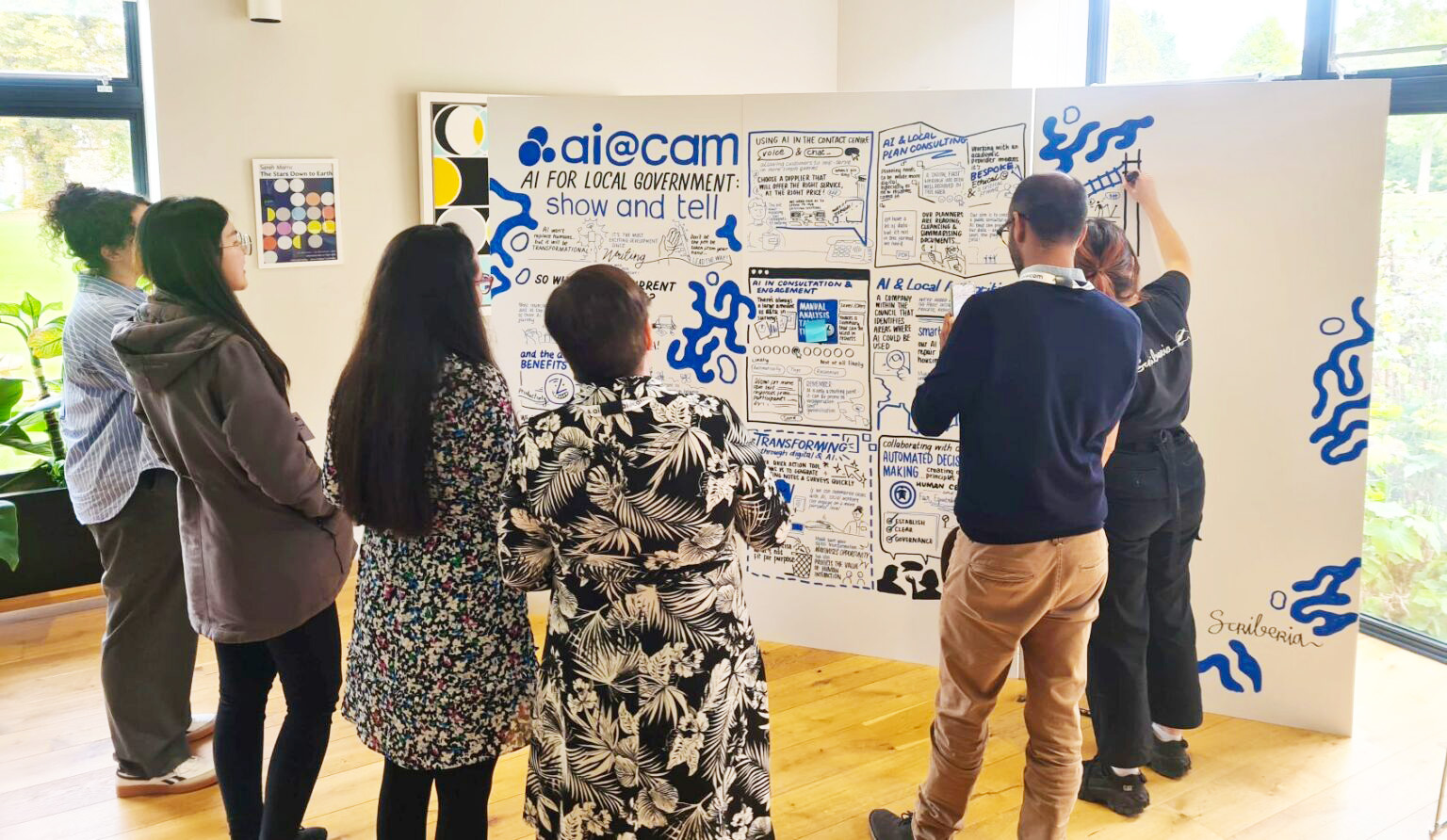
Photo from Connecting AI to public benefit