Jump to section
Public services across the UK are at a turning point. Demand continues to rise while capacity, skills and funding remain under intense pressure. Long waiting lists, fragile social care, housing shortages and stretched budgets are no longer isolated problems, they are symptoms of public service models that have not kept pace with the realities of the 21st century.
If nothing changes, the gap between what people need and what public bodies can deliver will continue to grow. The question for senior leaders is not whether change is required, but how to focus limited time, investment and leadership attention on the areas that will make the greatest difference.
This edition of Digital Trends is designed to support that judgement. Built on extensive engagement with Socitm members, sector surveys and international perspectives, it reflects what is already happening on the ground in local government and across public services. It highlights where digital capability is no longer optional, but essential to delivering outcomes, managing risk and sustaining trust.
The five trends prioritised for 2026 – cyber security, ways of working, data, Artificial Intelligence, and digital inclusion – are not presented as technology initiatives. They are leadership issues. Together, they describe the practical foundations needed to redesign services around places, support collaboration across organisational boundaries, build skills at every level, and embed ethical, adaptive change.
Digital Trends 2026 is intended to be used. For chief executives, senior officers and politicians, it provides a shared, plain-English view of what matters most and why. For officers and teams, it gives practical insight, real examples and a common reference point to support delivery, prioritisation and investment decisions. Encouraging your organisation to engage with the report helps create alignment between strategic intent and operational action.
As Socitm marks 40 years of supporting digital leadership in the public sector, this report reflects a shift from experimentation to maturity. Its focus is grounded in lessons you can apply, people you can call, and ideas that are already working. It shows how councils and partners are moving from legacy approaches towards more resilient, inclusive and outcome-focused models of service delivery.
Context and drivers
- Sustained financial pressure and skills shortages require new approaches to leadership, collaboration and service redesign.
- Demographic change, climate risk and rapid technological development demand whole-system thinking and adaptive capability.
- Digital transformation must be underpinned by governance, standards and inclusive design to maintain public trust and ensure equitable access.
Five digital trends prioritised for 2026
Artificial Intelligence
AI is moving from experimentation to everyday use in public services. The focus now is on responsible scaling, transparency, and using AI to augment – not replace – human judgement and expertise.
Cyber security
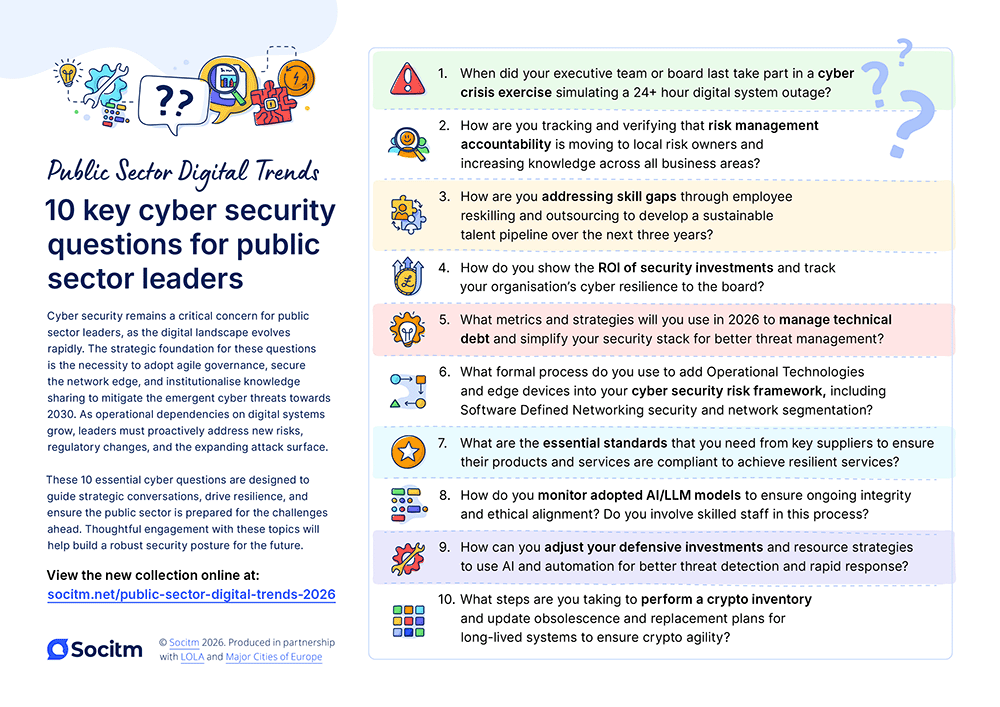
Cyber security has become a board-level concern. The next phase is about resilience: anticipating threats, reducing impact and strengthening organisational readiness in an increasingly hostile environment.
Data
Data is central to better policy, service design and decision-making. Progress depends on breaking down silos, improving data quality and maintaining strong ethical and privacy frameworks.
Ways of working
Traditional hierarchies are giving way to more collaborative, agile approaches. Success increasingly depends on leadership behaviours, learning cultures and the ability to work across boundaries through heightened partnership working and the application of data-led behaviours.
Digital inclusion
Digital inclusion is fundamental to fairness and effectiveness. This means addressing access to devices and connectivity, building confidence and skills, and designing services to be accessible from the outset.
A message for senior leaders
Digital change is not about technology alone. It is about culture, capability and focus. The organisations that succeed will be those that connect strategy to delivery, empower their people, and stay open to learning from peers.
As you look ahead to 2026 and beyond, Digital Trends 2026 offers a practical lens to guide discussion, challenge assumptions and support your teams to act with confidence. Share it, use it, and encourage your officers to engage with it – because the next phase of public service delivery will be shaped by the choices leaders make now.
A look back. A leap forward. Putting people and places first.