Jump to section
Making predictions is always a tricky business – “guess correctly three times in a row, and you can be considered an expert”, or so they say. However, circumstances can disrupt otherwise clear and foreseeable trends.
Here, we take a look at our success in accurately identifying trends over the past six years:
- What trends have persisted and which are new or changing?
- What have the fundamental drivers been?
- What did we get right, and why?
Whilst we did get most things right, we overestimated how quickly new technologies would be adopted. The pace varies between public service organisations due to differences in local geography, demography, resources, risk appetite, politics and leadership.
There are two clear lessons to be learned for organisations using our research in their own planning:
- Events get in the way and local priorities vary, so care and judgement are needed in how our digital trends apply in your organisation, to reflect local circumstances.
- Consider and learn from your organisation’s journey and strategic plans: Learning from where your plans required adjustment will allow you to build in greater flexibility or realism in the future.
Our analysis reveals that, although IT and digital capabilities in public services have evolved over the past six years, most trends and digital practices remain consistent year on year, taking time to develop and mature
The factors that have impacted the overall pace of digital and technology change from our analysis of the past six years have been:
- The Covid-19 pandemic, triggered unprecedented global digital adoption, accelerating remote work, digital public services, online learning, telemedicine, and e‑commerce.
- Cyber security threats, with a significant change due to AI-enabled risks. The growing dependence on digital services requires constant adaptation in technical, cultural and behavioural practices.
- Political and organisational challenges, including external pressures such as local government reorganisation and devolution present both obstacles and opportunities for digital transformation.
- Supply chain disruption and economic uncertainty, inflation, interest rates, budget constraints and supply-chain volatility, slowed tech investment temporarily but ultimately is pushing public sector organisations to modernise for resilience.
- Advances in Artificial Intelligence, AI moved from experimental to production‑scale deployment, especially generative AI.
Our digital trends assessments were mostly accurate but inevitably impacted by unforeseen external events.
Our technology trends assessments correctly identified where adoption of new technology was likely to take longer than industry pundits and suppliers often expected (or hoped).
Year by year assessments
This year by year assessment of our digital trends reports for the last six years, highlights some of the key findings that proved to be accurate and those that we did not foresee.

2020
The 2020 digital trends report was published just before Covid struck. That was an unavoidable major oversight. We predicted a strong and growing focus on technologies such as artificial intelligence, Internet of Things, 5G and we expected greater adoption of digital transformation as a mechanism for exploiting greater value as resources became increasingly constrained.
What we got right:
- We accurately predicted a trend of changing workstyles (although not the extent to which Covid would impact working practices)
- The technology trends we identified (e.g., AI, IoT and 5G) becoming increasingly mainstream, including a growth in home and mobile working.
- We also spotted the emergence of new models of cross-sector working which were in practice magnified by the lockdown.
What we got wrong:
- We did not foresee the impact of the Covid-19 pandemic would have, skewing priorities towards connectivity, video conferencing and prioritisation of remote access to services.
- Perhaps the biggest impact of the pandemic was the massive move towards accepting digital delivery within public services and by citizens – much faster than we could have foreseen.
2021
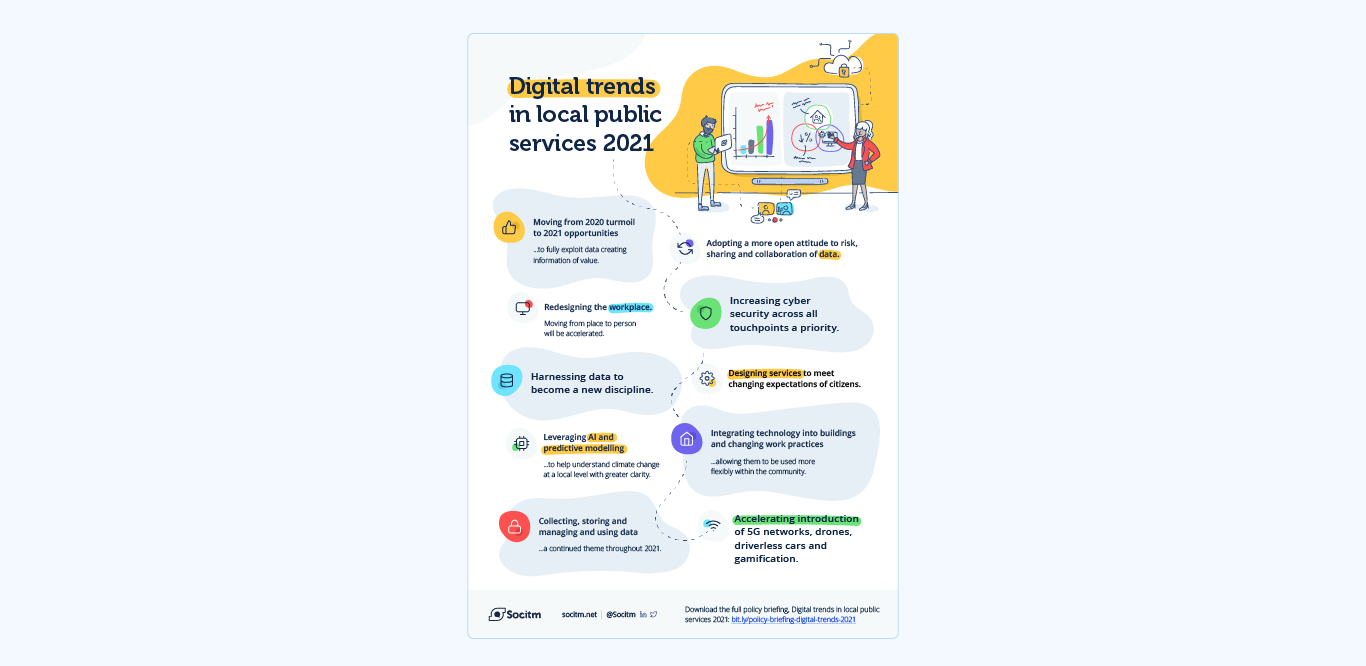
Still in the Covid period and feeling its effects on digital adoption, we predicted a strong focus on digital leadership and the need to redefine digital services around people, with less focus on IT catalysts in their own right. In particular, we anticipated a shift towards digital and data at the heart of service planning and new working patterns becoming a staff wellbeing requirement.
What we got right:
- We foresaw the need to consolidate IT change after the response needed for Covid, particularly addressing exposed risks from the rapid adoption of digital services.
- We correctly tracked the trend towards the importance of data – noting how crucial shared and integrated data had been in response to the pandemic.
- We also spotted the need to proportionately increase IT budgets – whilst reflecting that this would still be tough on IT leaders making business cases for investment.
What we got wrong:
- We wrongly predicted a fundamental shift occurring this year towards localism and urban redesign – an opportunity flowing naturally from the impact of the pandemic. In practice, this has proved to be a ‘slower burn’ in some countries such as the UK, where there is a reluctance to change in some services.
- We also expected to see a more rapid shift towards new supply models than proved to be the case – although this is a continuing trend; it is taking time to mature as contracts come up for renewal.
2022
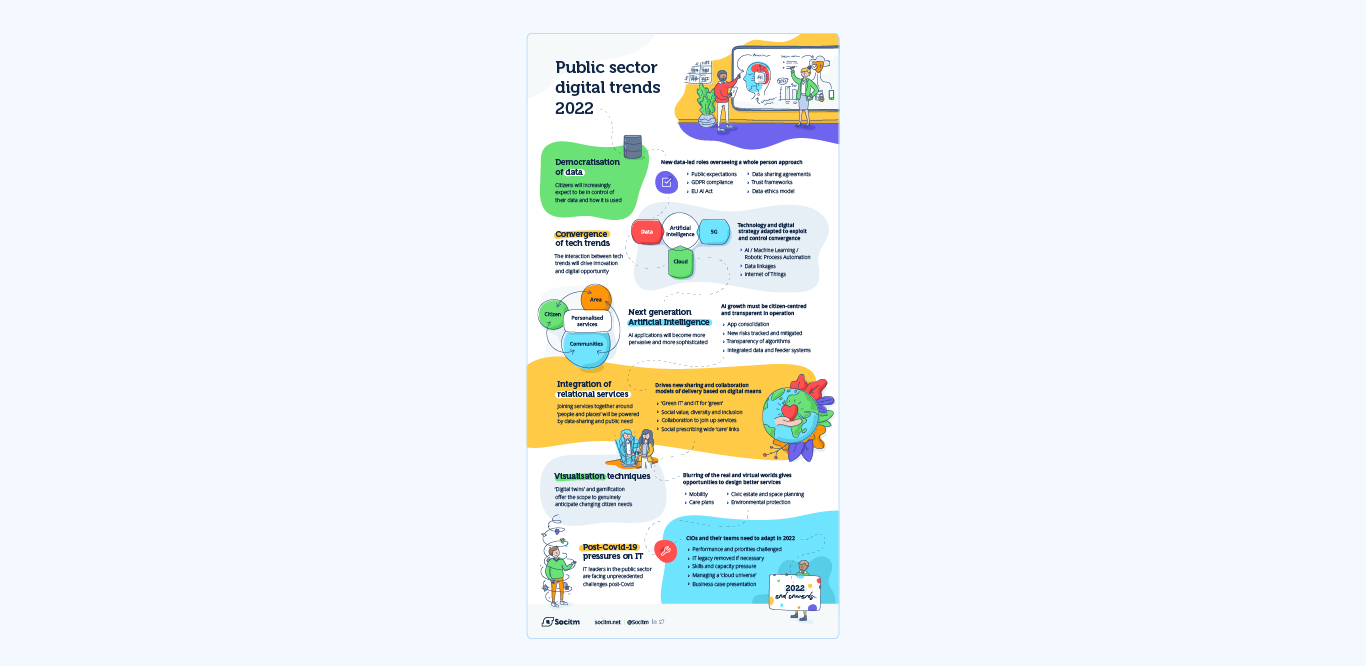
We saw 2022 as the year of significant change in service modelling in favour of digital delivery, building on the successful response to the pandemic. This included resetting risk models in favour of digital delivery, with a wider acceptance of online-only services. Our expectation was a surge in digital ‘pace and reach’ in the public sector, with designs that empower people, not depersonalise, or disenfranchise.
What we got right:
- We correctly predicted the growth in collaborative networks and in prioritised development of personalised digital services.
- The need for better cyber resilience planning for communities, not just in public services or systems
- The need for a data strategy in organisations to control AI and IoT developments and to avoid a patchwork of incoherent digital systems and services.
What we got wrong:
- We did not anticipate the wider impact of economic downturn on the public sector and the tightening of finances resulting from international conflict and energy costs rises. These put a break on some projects and demanded higher return on investment with a tightening of finances.
- We also expected the emergence of a common inclusive ‘trust framework’ across public services, providing a platform for interoperability of digital identity solutions. This has proved more challenging in many countries, including the UK, and this has held back some digital public services.
2023
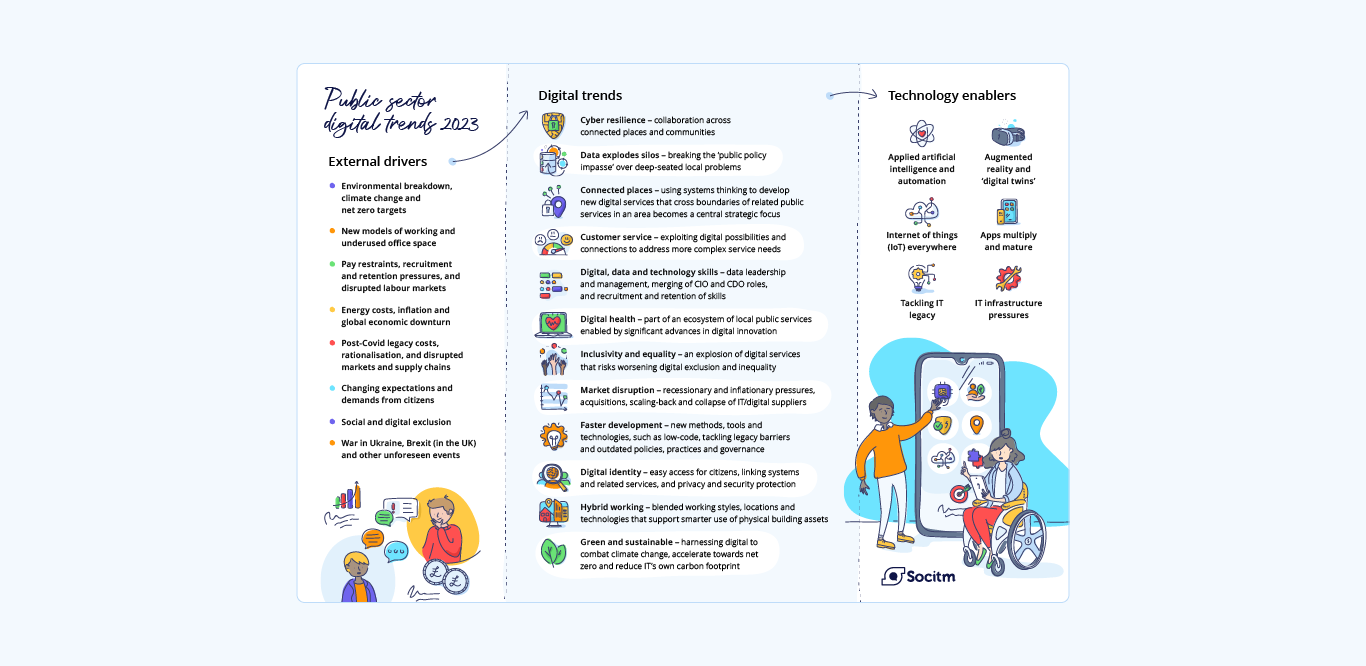
In our 2023 report, we were correct in seeing a growing expectation of ‘digital’ to mitigate the impact and the growing problems facing public sector leaders: austerity, global economic conditions, growing public expectations, the cost of living crisis, the need for integrated services across traditional boundaries, climate change, and recruitment and retention challenges with changed workforce expectations.
What we got right:
- We foresaw the growing prioritisation of ‘channel blending’ – the critical role of connecting services and providing easy to use online services to reduce inequalities.
- A nuanced approach to the challenge of legacy IT – not everything has to be replaced and there are alternative strategies that can be deployed to mitigate the constraints of older technologies.
- The fundamental role of data integration to break away from the limitations imposed by service silos, and the growth of data science as an important professional discipline.
What we got wrong:
- We expected digital health services to set the pace and example for digital services for citizens, partly because of the potential of technology, and partly because of the ubiquitous nature of health services. In practice, this is taking longer than we thought, and may still be some years away from becoming a reality.
- It is, perhaps too early to tell, but the pace of data governance maturity, the adoption of personal data vaults and integration of data across organisational boundaries appears to be taking longer than we had thought (or hoped).
2024
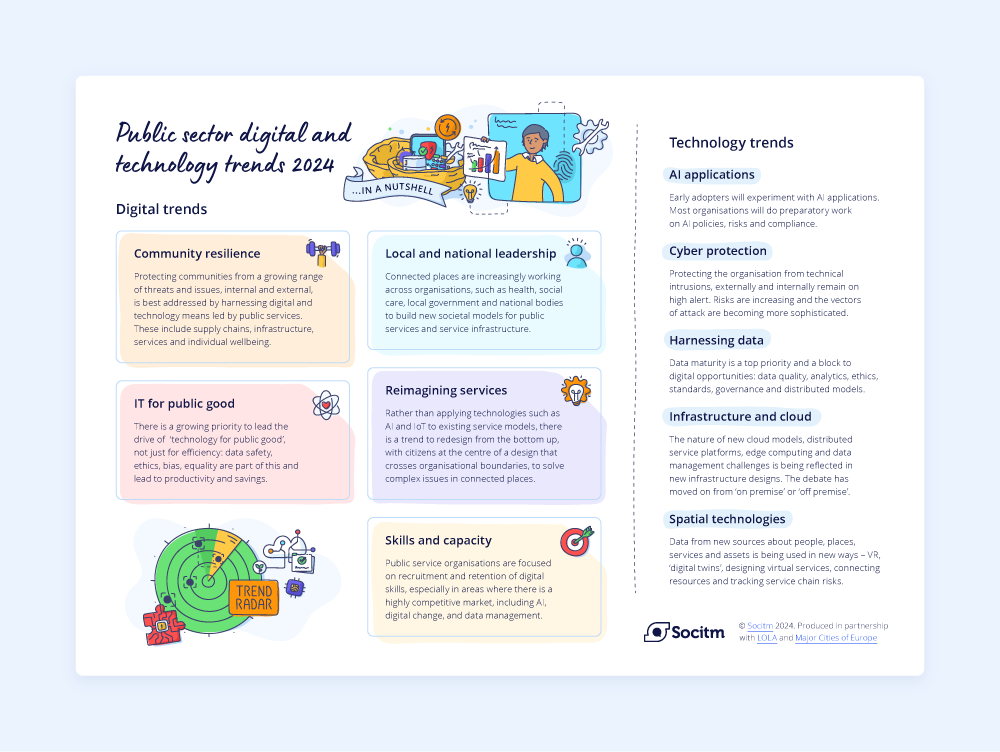
Our analysis pointed to several emerging trends:
- Artificial Intelligence is being actively deployed with proofs of concept and trials but beware of the hype.
- Data is becoming critical but is widely undervalued and misunderstood.
- Cybersecurity remains a constant trend with an imminent step change coming, enabled by AI.
- Collaboration, especially in connected places is growing steadily but surely, despite resistance (CIOs, CEOs, politicians etc all have vested interests). Even the Integrated Care Boards established by the NHS in England are not grappling with this yet in any way that is effective.
Many of the issues highlighted in 2024 remain current. For example:
- Impact of underinvestment in public services/digital/IT infrastructure that holds back progress, increases inefficiency and throttles back productivity.
- Skills remain a key issue – digital leadership at the top table especially, but also specialist skills in IT teams and modernised ‘recognition and reward’ systems. (We are still rewarding the wrong things in the public sector.)
- Finding it hard to find the space, risk appetite, resources, prioritisation for the big change programmes. It’s why many public service organisations such as hospital trusts end up buying new technology, and systems, rather than implementing complex change
We also have some political issues to contend with, especially in the UK:
- With the focus on all manner of external pressures, how do digital, data and technology (DDaT) related requirements get a look in?
- Digital leaders need to be more politically astute and prepare for the opportunities created by local government reorganisation and increasing devolution.
- We need a much better model for DDaT innovation: risk frameworks, project management methods, appetite for change, culture, horizontal leadership and governance, greater investment, business case frameworks, expectation of accountability for benefits realisation, and remuneration and reward systems that reflect the value that innovators bring to the public sector.
Technology trends remain the easy bit, continuing to trundle along nicely (e.g. AI, robotics, intelligent infrastructure), but ‘digital’ remains hard, illusive and often avoided because of the displacement of traditional functions in cross-cutting and multi-agency working.
2025
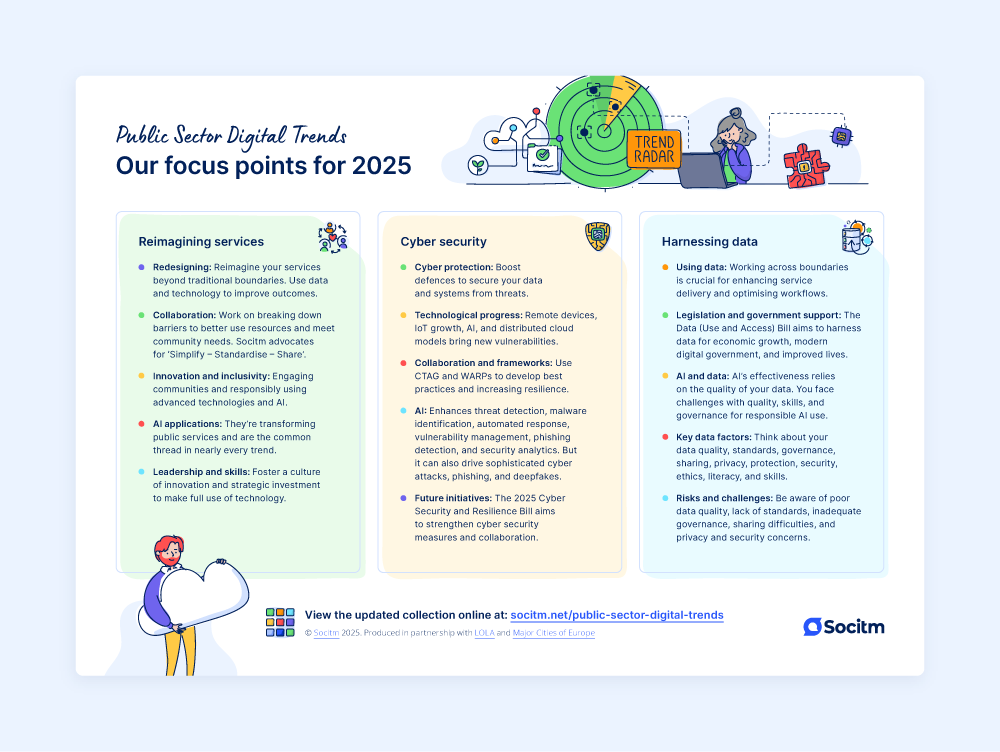
Our analysis for this year dived into three emerging trends:
- Artificial Intelligence being actively deployed with proofs of concept and trials but beware of the hype.
- Data becoming critical but is widely undervalued and misunderstood.
- Cyber security remains a constant trend with an imminent step change coming, enabled by AI.
We chose these key trends for 2025 as they represent the main drivers of digital transformation in the public sector.
Artificial Intelligence has rapidly transitioned from theory to practice, driving new efficiencies and possibilities, while data underpins every aspect of digital operations, yet still faces challenges around recognition and effective usage and cyber security is crucial as digitisation and AI adoption introduce new risks, requiring constant vigilance and adaptation.
These trends persist because they are foundational to sustainable progress, resilience, and innovation in an environment marked by ongoing technological advancement and evolving threats. However, the realisation of these trends has been hindered by persistent challenges within organisations.
In 2025, for example, only 16% of UK public sector organisations had fully implemented their digital strategies (down from 23% in 2023) a backward slide reflecting persistent obstacles, according to the State of Digital report. Some internal factors like lack of digital leadership, limited funding and shortages of digital skills have constrained the capacity for change. For instance, some councils have postponed planned data platform upgrades due to uncertainty around merger timelines, illustrating how reorganisation can delay digital progress.
In the UK, Local Government Reorganisation (LGR) and expanded devolution have added new layers of complexity to these efforts. While these reforms aim to streamline services, in practice they have introduced uncertainty and shifting priorities at the local level. Many councils facing merger or reorganisation have slowed down long-term investments in digital systems, wary of implementing changes that might be undone or duplicated under new structures
Despite these setbacks, the commitment to digital transformation remains evident across the sector, with organisations continuing to adapt and innovate in response to evolving challenges. Looking ahead, success will depend on maintaining flexibility, investing in skills and leadership, and fostering a culture that values data-driven decision making. As the landscape changes, those able to navigate uncertainty and prioritise digital resilience are likely to be best positioned for future progress.